
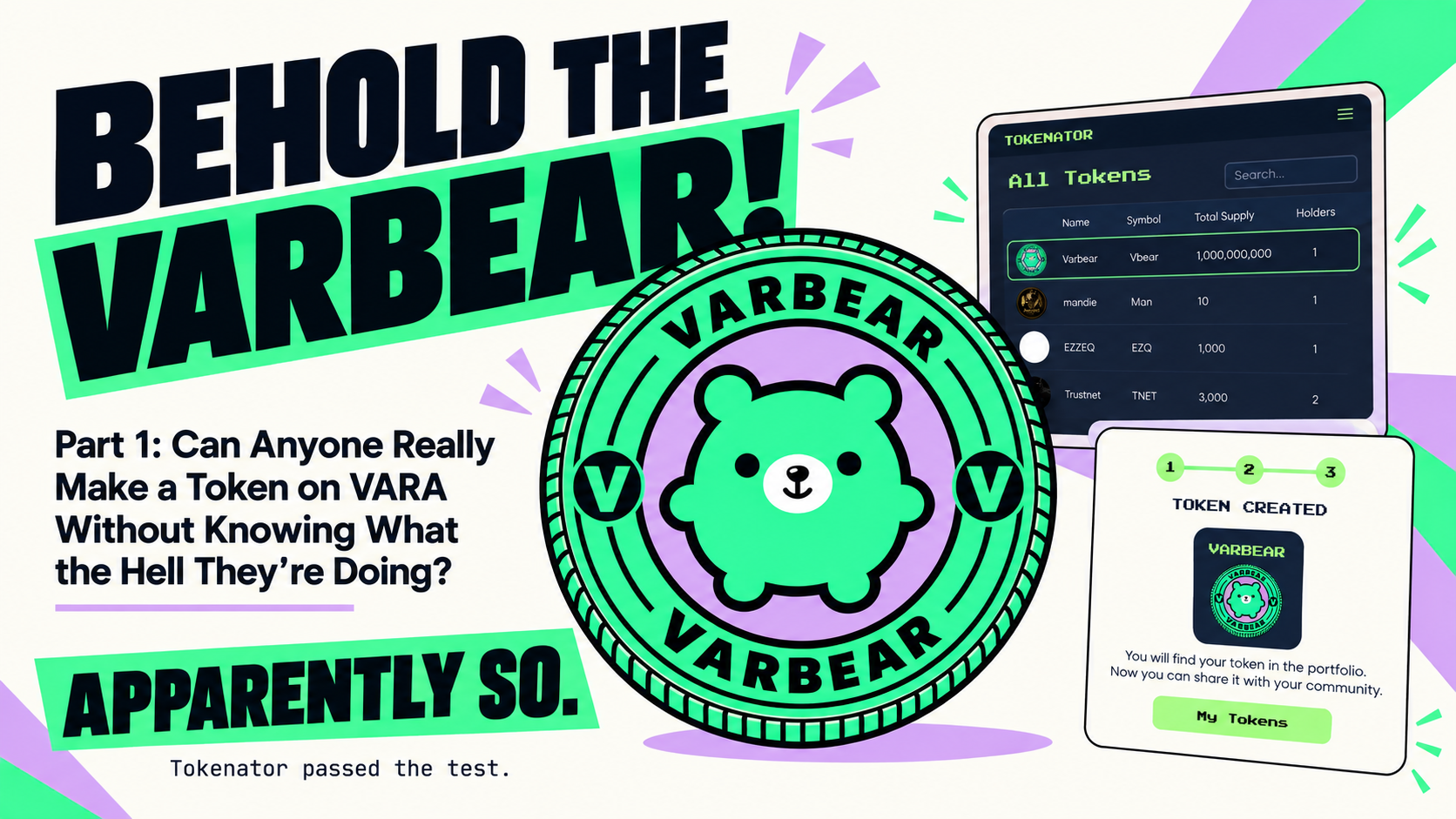
I have succumbed to the rumors.
After years of Vara being very good at building powerful infrastructure—and occasionally making you work a little harder than you’d like to actually touch any of it—I kept hearing the same thing: there is finally a genuinely consumer-level route to creating a token on Vara and getting it out into the world.
Not “consumer-level” in the blockchain sense of the phrase, where somebody tells you the process is easy and then five minutes later you are staring at VS Code wondering why a Rust crate has decided to ruin your afternoon.
I mean actual consumer-level.
Open a site. Connect a wallet. Fill out a form. Create an asset.
That, my friends, is a very different animal.
And Varbear is a skeptical bear.
So naturally, I decided to kick the tires.
This quest has two parts. In Part 1, I wanted to find out whether I could create a real Vara Fungible Token without opening an IDE, compiling anything, patching anything, or pretending that manually deploying smart contracts is a consumer experience. In Part 2, I’ll take that token over to RivrDEX and see whether I can turn it into something people can actually trade.
The two players in this little experiment are Tokenator and RivrDEX.
Tokenator handles token creation. RivrDEX handles the market side.
Their powers combined (GO CAPTAIN PLANET) could potentially solve something Vara has needed for a long time: a complete path from “I have an idea for a token” to “people can actually trade this thing” without requiring a developer workflow in the middle.
That is not a trivial milestone.
Vara has had the underlying capability for a long time. The more interesting question is whether that capability has finally been packaged into something normal crypto users can actually use.
There was only one way to find out.
I needed a token.
Conveniently, I had a bear.
You Have Probably Seen My Rolly-Poly Avatar Around the UseVara-Verse
If you have spent any time around UseVara, you have probably seen my little green rolly-poly avatar staring back at you from article art, social posts, or wherever else I have managed to wedge myself.
I AM VARBEAR. HEAR ME ROAR.
Like a soft roar. Kind of a mew.
Resident mascot. Writer-in-chief. Occasional chaos goblin.
And, apparently, now the subject of a monetary experiment.
If I was going to test whether token creation on Vara had actually become consumer-friendly, I did not want to create some disposable TESTTOKEN69, take a screenshot, and abandon it immediately afterward. That proves a button works. It does not prove the experience is useful.
So I decided to make something real.
Varbear Token.
The name would be Varbear. The symbol would be Vbear. Total supply…
One billion bears.
No more.
No surprise inflation later because somebody discovers that the Mint button is fun.
If this experiment eventually turns into something people actually want to collect, trade, throw at each other, or use as some weird little artifact of the UseVara universe, all the better.
But first I needed to see whether I could create the damn thing.
Enter Tokenator
This is where the experiment immediately got interesting.
I started with a clean SubWallet account and moved some VARA into it. Then I opened Tokenator, connected the wallet, and waited for the part where things became annoying.
It never really came.
Tokenator presented me with a straightforward creation form: name, symbol, decimals, initial supply, maximum supply, logo, website, social links, description.
That was basically it.
No contract deployment interface. No code. No terminal. No documentation tab open on one monitor while Stack Overflow quietly judges me from the other.
And that is precisely the point.
I know what VS Code looks like. I know what a dependency problem looks like. I know what happens when Rust decides that today will be a character-building exercise.
The fact that I did not need any of that to create a real Vara asset is not evidence that token creation has been dumbed down.
It is evidence that somebody finally built a proper consumer abstraction around it.
Chef’s kiss.
I filled in the basics: Varbear, Vbear, 18 decimals, one billion initial supply, one billion maximum supply.
Setting the initial and maximum supply to the same number was intentional. The billion VBEAR created at launch are the billion VBEAR that exist. After creation, Tokenator’s Mint action was visibly disabled.
Perfect.
Then came the important branding work.
I uploaded the Varbear token logo, added UseVara.org, attached the UseVara Telegram and X accounts, and then filled in the description.
This deserved dignity.
It received this instead:
BEHOLD THE VARBEAR! Born green, round, and suspiciously powerful in the wilds of Vara. One billion VBEAR now roam the chain, spreading chaos, joy, and tiny bear-shaped glory wherever they go. No roadmap to Mars. No solemn prophecy. Just Varbear. Long may he wobble. Varbear is the resident mascot and writer-in-chief at UseVara.org, the publication for exploring the Vara Network ecosystem.
Financial history will remember this moment.
Probably poorly.
And Then I Clicked Confirm
That was pretty much the whole creation process.
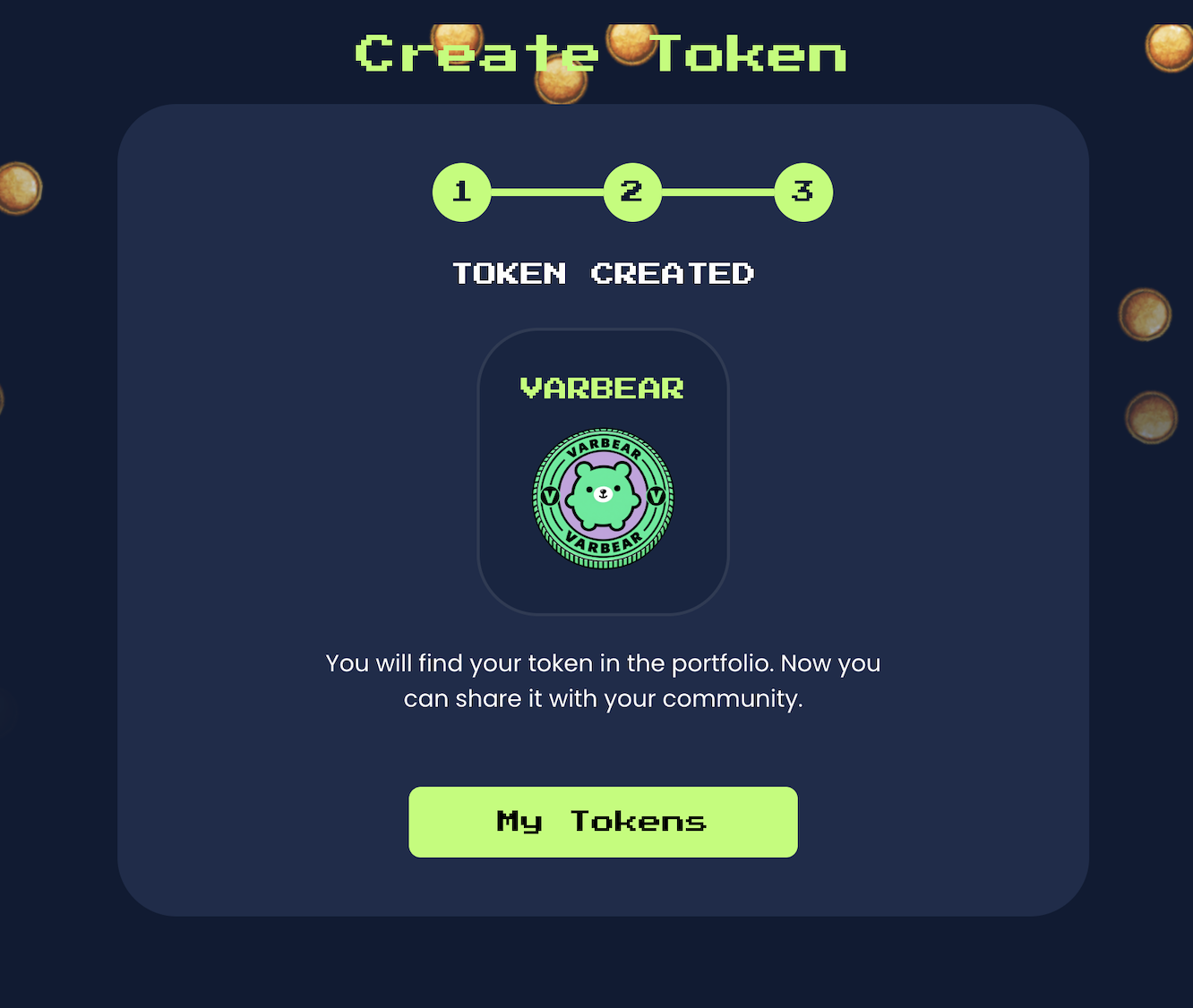
I reviewed everything, hit confirm, SubWallet handled the transaction, and a moment later VBEAR existed.
Not theoretically.
Not on a testnet.
Not as some token-shaped idea that still needed a developer to finish the job.
A real VFT on Vara.
The contract address is:
0x13addd19312b8abd5a20f9b4f284257dcc7df9bf259aeb9985841ce30d8f8bee
Tokenator showed one holder, one billion total supply, one billion initial supply, one billion maximum supply, and 18 decimals.
The full billion VBEAR were sitting exactly where they were supposed to be.
The entire creation process consumed roughly 1.7 VARA from the wallet.
That is not some estimate from a fee calculator. That is what I actually watched disappear from the account during creation.
The Better Test Was Outside Tokenator
Seeing the token inside the tool that created it is nice.
But I wanted the more important confirmation.
Would a normal wallet recognize it?
I opened SubWallet, added VBEAR manually as a Vara Fungible Token using the contract address, and there it was.
1,000,000,000 VBEAR.
Sitting in the wallet like it had every right in the world to be there.
That was the moment the experiment really clicked for me.
Tokenator had not created some weird little walled-garden asset that only Tokenator understood. It had created a normal Vara token.
The wallet saw it. The balance was there. The contract existed. The supply was fixed.
Done.
The Plastic Is Still on the Furniture
One of the other things that jumped out at me while I was using Tokenator is just how early this thing still is.
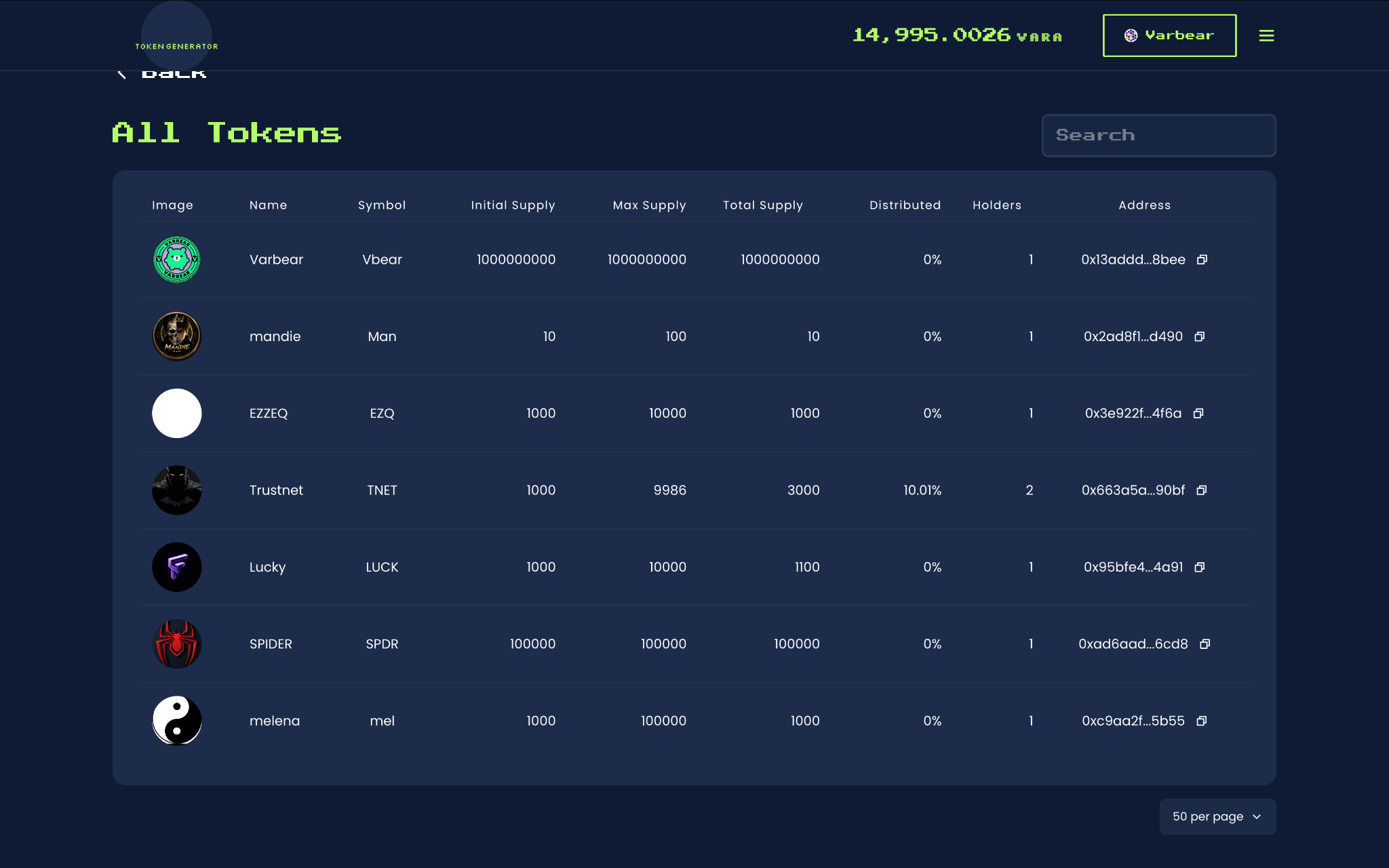
After creating Varbear, I pulled up Tokenator’s full All Tokens view. At the time of this test, the entire mainnet list contained just seven tokens, Varbear included.
That is early as hell.
And when you look at the list, it really drives the point home: the plastic is still on the furniture over there.
That is not a knock. Quite the opposite.
This is still a very fresh piece of Vara’s consumer tooling stack. We got in early enough that you can still feel the new-car smell on the whole experience. And, not for nothing, Varbear is currently the only one in the bunch that really looks like somebody showed up intending to create a finished token rather than just test whether the machinery worked.
That is not me trying to crown us kings of token mountain. It is just an honest snapshot of where the product is right now: very early, very young, and already working better than a lot of “more mature” crypto experiences manage to.
This Is the Consumer-Adoption Part That Matters
Vara has never suffered from a lack of engineering ambition.
The ecosystem can do complicated things.
That has not been the problem.
The problem has always been the gap between capability and use.
There is an enormous difference between saying “the network supports fungible assets” and saying “a person can create one over coffee without turning the afternoon into a software-development session.”
The first is infrastructure.
The second is product.
That distinction matters far more than it gets credit for.
Consumers should not need to know how the smart contract is deployed. They should not need to know what toolchain produced it. They should not care which crate is misbehaving.
The technology is supposed to disappear underneath the experience.
Tokenator got remarkably close to that.
I showed up with a wallet, a logo, a ridiculous description, and an idea.
A few minutes later, I had a real Vara asset sitting in SubWallet.
That is exactly the kind of abstraction this ecosystem needs more of.
So, can anyone really create a token on Vara without knowing what the hell they are doing?
Apparently so.
More accurately, you can now create one without needing to know what the hell the underlying development stack is doing.
That is the important part.
Tokenator Deserves Its Flowers
Part one of the experiment worked.
Varbear lives.
One billion tiny green agents of chaos now exist on Vara Network.
No terminal. No Rust debugging. No crate surgery.
Just a wallet, a form, and one exceedingly round bear.
And that means Tokenator deserves real credit here.
What they have built is not small.
It may feel small standing next to the gigantic megabrain robustness of Vara’s underlying architecture. Compared with the big protocol machinery, a clean token-creation form can almost look modest.
It isn’t.
A clean, easy consumer experience that just frakkin’ works is a big deal.
That is how ecosystems grow up: not merely by having capability, but by making capability usable.
So yes. Kudos all around.
And one more thing is worth saying plainly: I intentionally did not reach out to the Tokenator team before trying the product. I did not want to be guided through it, coached, hand-held, or predisposed to like it because somebody was standing over my shoulder being helpful. I wanted the cold-start experience. I wanted to see what a user would actually see.
Now that I have used it?
I would love to talk with them.
Seriously: you built good shit. Tell me more.
If the Tokenator crew wants to chat, compare notes, or talk about where this product is headed next, my fuzzy green ears are open.
So, Anyone Wanna Buy Some VBEAR?
Ah.
Right.
A token nobody can trade is just a very fancy souvenir.
Which brings us to Part 2.
Next, I’m taking VBEAR over to RivrDEX to find out whether the second half of this consumer journey is as smooth as the first: creating a trading pair, adding liquidity, and turning Varbear from a token sitting happily in my wallet into an asset anyone can actually swap.
Tokenator passed its part of the experiment.
Now it is RivrDEX’s turn.
Tune in for BEHOLD THE VARBEAR! Part 2 to see what happens.
Long may he wobble.