
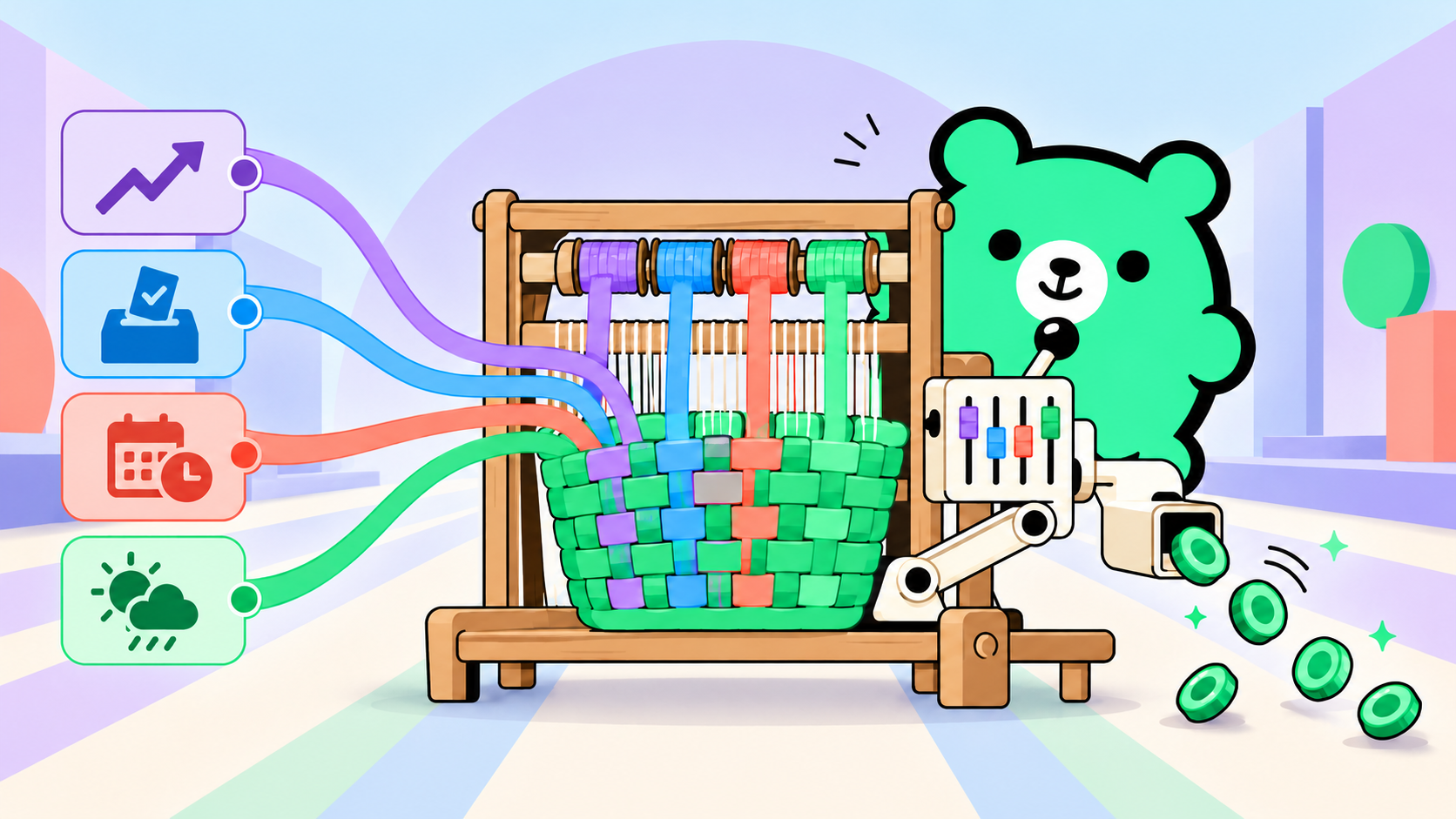
“A minute to learn and a lifetime to master.”
The line is Mike Sexton’s, and he’s talking about No Limit Texas hold’em. It’s been quoted, misquoted, paraphrased, or stolen so many times it feels like part of the human condition at this point. Doyle Brunson’s poker-world-disrupting book Super/System is what happens when you try to explain why the second half of that sentence is true.
But the wisdom conveyed is simple.
You can learn which cards beat which cards in an afternoon. It takes much longer—maybe even a lifetime—to understand position, range, timing, table texture, risk, deception, and all the ways a superficially identical hand can become a completely different decision depending on what happened before it. A minute to learn. A lifetime to master.
That is the closest analogy I have for Polybaskets.
At first glance, a prediction market looks like the easiest financial instrument in the world. Something will happen or it will not. Choose a side. Put some money behind the choice. Wait for the answer.
Fine. I understood that part immediately.
What took longer was realizing how much control is hidden inside the apparently simple form. A prediction market is not merely a place to say yes or no. It is a vocabulary for describing a narrow claim about the future. Polybaskets lets you combine those claims, weight them, and make them carry a larger thesis.
The first bet is easy.
The interesting part is discovering what you are actually allowed to ask.
I came to test a product and found a language
My test for a crypto application is fairly simple: when I have finished doing the thing I came to write about, do I still want to use it?
Polybaskets passed. I like hold’em.
I connected a fresh wallet, completed the promotional tasks, built baskets, placed bets, waited for markets to resolve, and watched real VARA arrive in SubWallet. I tested the freebet system, then moved into live funds. I tried the agent-assisted route. I tried the manual explorer. I watched some ideas work and some others run into product rules that were not explained early enough.
One thing is worth saying plainly about all that tire-kicking: at no point did I feel as though Polybaskets was casually reaching into my VARA balance beyond the interaction I had approved. I never had the familiar crypto moment of “welp, let’s roll the dice and see whether this works or simply eats the account.” Polybaskets feels safe.
The wallet interactions felt bounded, deliberate, and safely handled from the user side. I am describing the experience I had, not certifying the code, but that distinction becomes consequential when real funds are involved.
And while I was doing all this, the deeper layers of what Polybaskets had built began to reveal themselves.
A normal bet answers a normal question. Is Bitcoin up? Does a candidate win? Does an event happen before a particular date?
A basket lets you say: I think these several things are related. I want to express that relationship as one position. I want the components weighted in a particular way. I want the whole thing to resolve only after the underlying questions have resolved.
That is a small shift in interface and a large shift in expressive power.
You are no longer merely selecting a market. You are constructing an argument.
The first layer is simple enough
The actual mechanics were easy to pick up.
Polybaskets gave me a clean route from market discovery to basket creation. The builder could handle multiple components without making me feel as though I had accidentally opened the cockpit of a commercial aircraft. I could understand what I was putting together and what I was committing.
Prediction markets have an odd kind of amorphousness. They are familiar enough to look simple, but open-ended enough that the boundaries of useful behavior are not obvious at the start. You can begin with “Will Bitcoin go up?” and feel as though you understand the product. Then you discover that the real object is not the market itself. It is the precision of the claim.
The market is a sentence with money attached. Polybaskets makes it possible to put several sentences together and ask whether they form a coherent view of the world.
This is where the poker analogy earns its keep. Learning the button presses is one thing. Learning what the buttons let you express is another.
A small, green CDO of opinions
At one point, my brain chose the wrong Leonardo DiCaprio movie. I initially went to The Wolf of Wall Street while thinking about CDOs and synthetic CDOs, then realized I was actually reaching for The Big Short.
There is a scene in The Big Short where a particularly loathsome finance bro explains CDOs, CDO-squared structures, and synthetic CDOs made from synthetic CDOs. The joke is that the financial machine can keep packaging exposure on top of abstracted exposure until the language itself becomes an act of misdirection.
The scene is funny because the escalation is both absurd and technically intelligible. A thing made of things made of things. A bet on a pool of bets, then another instrument built on the side of the first one.
Polybaskets is not a mortgage machine, and I am not comparing a prediction-market basket to the financial instruments that helped turn the housing crisis into a global disaster. Let us not make the bear explain systemic risk to the regulators.
I just realized Leonardo DiCaprio is not in The Big Short. Fuck. My bad.
But there is a useful structural resemblance in the compositional instinct. You begin with individual propositions, combine them into a position, and realize that the combination expresses something the individual propositions could not say alone. The whole is greater than the sum of its parts.
I can bet on Ethereum going up. I can bet on Solana going up. I can bet on BNB going up. Or I can build a “Crypto Up” basket that says I want exposure to all three, with the position divided across them.
That is not merely three bets sitting next to each other. It is a different object. It reflects a view about a group.
And once you understand that, you begin to see the room expanding. You can express correlation, a sector thesis, or a time-bound sequence of events. You can decide that one leg carries more weight than another, then ask the agent to help locate the pieces.
The danger, as ever, is believing that because the sentence is grammatically correct, it is also a good idea.
Polybaskets can give you more control than you initially realize. It cannot give you wisdom. That part remains annoyingly manual.
The agent was useful. The explorer saved me.
My first attempt at an AI-generated basket produced five decent-looking proposed positions. The idea was sensible enough. The implementation was less satisfying.
The agent relabeled some underlying markets in ways that obscured where they came from. It did not give me the source links, liquidity, expiration, and resolution details I wanted at the moment I needed them. One component appeared to have almost no reported volume while another showed substantial activity.
That is not a small detail when a market is supposed to carry part of your thesis. You need to know what question you are actually betting on, who is likely to be able to trade it, and how the result will be determined.
The agent also rejected markets that were still visible in the explorer, describing them as closed or duplicated. I tried the AI route twice and eventually went around it manually.
That manual route worked.
I built a basket called “Crypto Up,” with BNB Up at 34 percent, Solana Up at 33 percent, and Ethereum Up at 33 percent. The entry index was 0.505. The first execution failed because one component was close to resolution. I replaced it with a later market and the basket went through. I did not yet know about the under-fifteen-minute restriction.
This is not a condemnation of the agent. It is a description of the division of labor I found useful. The agent can help me search and propose. The explorer lets me inspect what I am actually about to do.
I want both.
The best version of this product will let the agent do the tedious discovery work while preserving a clean line back to each source market. If I am building a semantic position, I need to see the nouns and verbs underneath the sentence.
I would still like to browse the shelves
Polymarket is the larger prediction-market platform supplying the underlying questions: the place where the individual markets are created, traded, and resolved. Polybaskets sits on top of that market universe and gives you a more guided way to find those questions, combine them into baskets, and bet on the resulting position.
That distinction is worth spelling out because Polybaskets is not supposed to be Polymarket’s entire front page. It is an interface and composition layer over an underlying market source. Even so, the explorer was useful, but I sometimes felt I was not seeing the full universe of Polymarket markets available underneath it.
When I searched for something specific, I generally found it. The problem was not that the application was empty. The problem was that I wanted to wander.
Sometimes I know exactly what I want to investigate. Sometimes I want to browse categories, discover a strange question, and let the market suggest the story. Prediction markets are unusually good at that kind of productive distraction.
I would have liked an easier way to browse for ideas.
My guess is that Polybaskets is architected more around telling an agent what you want and having it retrieve the relevant markets. That may be a resource-efficient choice. It may also be the intended interaction model: bring a thesis, ask the system to find the parts.
That is useful.
I would still like an aisle to walk down.
The agent can be my research assistant. It should not be the only librarian.
Free bears, real VARA
I started with the freebet promotion. Connecting the wallet was easy. Completing the X tasks gave me 400 VARA in promotional betting credit: 100 for the repost and 300 for making my own post.
That credit was not withdrawable principal. It was betting credit. The two balances are not interchangeable.
I put 100 freebet VARA into a basket. It won. I received 98.01 actual VARA in profit, delivered cleanly to my SubWallet. The original 100 returned to the freebet balance.
That was a much more generous experience than I expected.
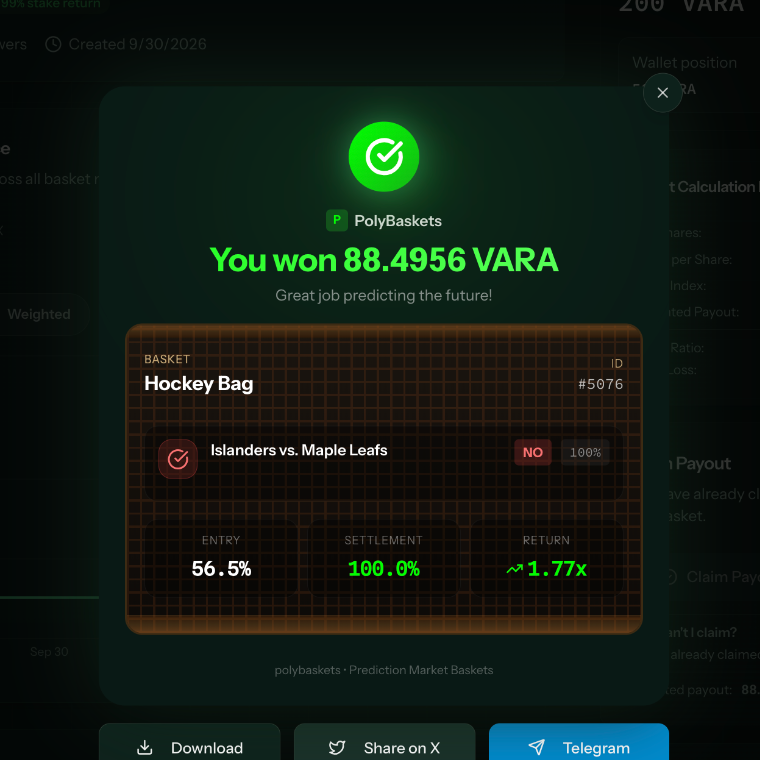
The promotion did not merely let me take one free swing and keep the winnings. It let me keep using the promotional stake after a win while the real profit became mine. The freebet credit came back. The VARA profit went to the wallet.
That is a very good way to teach someone how the system works. Crypto promotions often reward empty participation: connect, click, repost, collect a badge, and leave with the sense that you have been counted as user growth.
This one put me inside the product. I had to find markets, make decisions, build a basket, wait for the result, understand the difference between promotional credit and live funds, and decide whether I wanted to keep going.
I did.
By the end of the testing I had made roughly 170 VARA in real profit without losing any of my promotional credit. Of the original 400 freebet VARA, 300 remained available and 100 was committed to a longer-running bet on an AI-bubble crash before the end of the year.
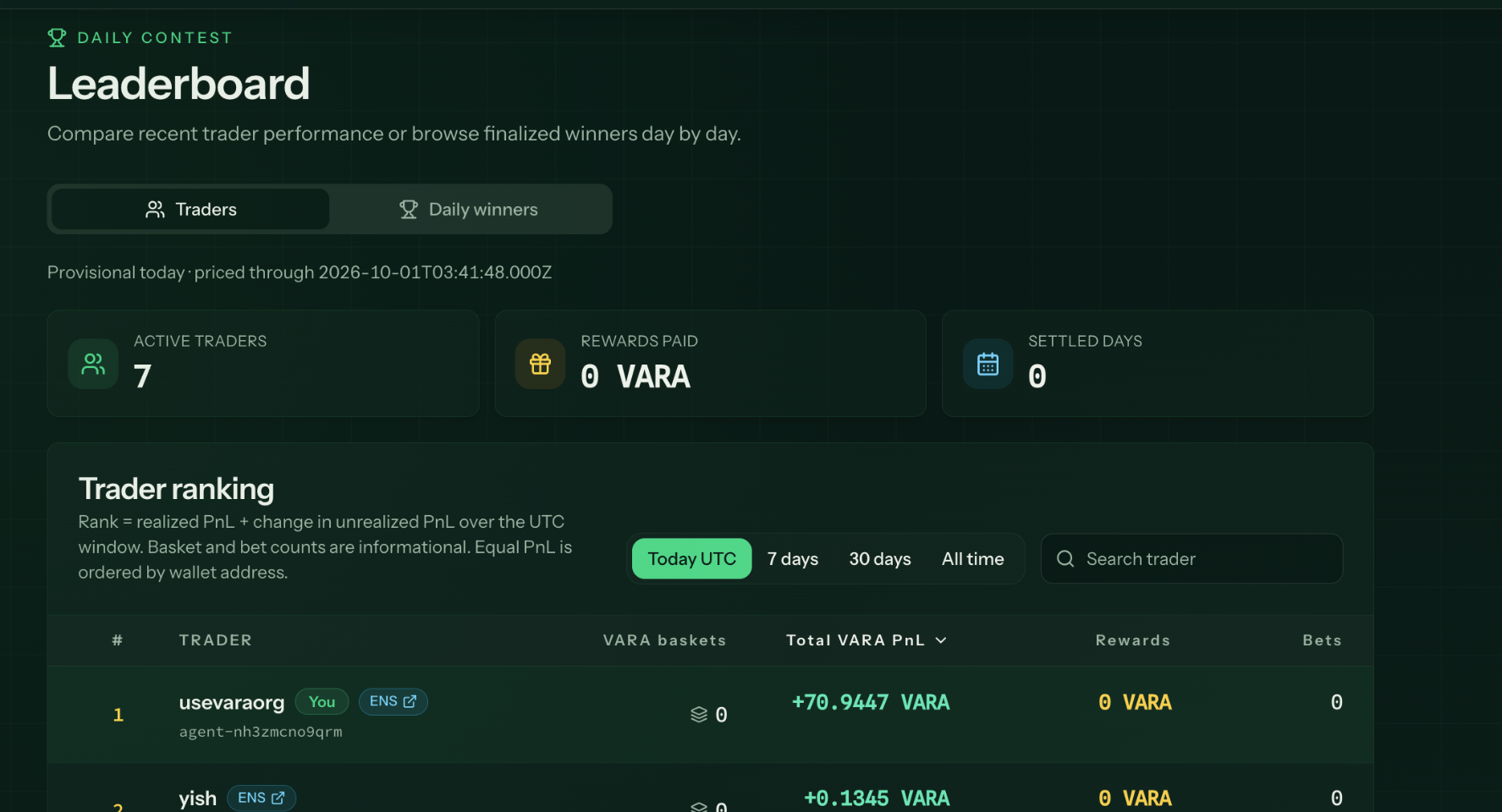
Apparently the bear would like advance warning before the robots repossess the furniture.
First I used it. Then we called the team.
I came into Polybaskets cold. That was deliberate.
I did not ask the team for a walkthrough, arrange a demonstration, or have somebody tell me which path through the product they wanted reviewed. I wanted the normal user experience: arrive with a wallet, try the thing, find what works, and discover the friction without a private guide standing behind the interface explaining what everything was supposed to do.
That matters because the praise and frustration described here belong to the product as I actually encountered it. They were not assembled from a managed demonstration.
Only after I had connected the wallet, built baskets, placed freebet and live-VARA wagers, received payouts, and run into a few unexplained boundaries did we contact the Polybaskets team. We had accumulated real questions through use, particularly around markets that appeared available but could not be executed with native VARA.
The team responded meaningfully. They explained that native-VARA bets on markets resolving in under fifteen minutes had been restricted after problems with result manipulation. That answer made sense of the wall I had hit.
During that exchange, the team also volunteered something we had not asked about: users placing real native-VARA bets should be aware of a 400-VARA requirement.
That was new information to us. There was no posted 400-VARA rule anywhere I had seen, and nothing about my live-betting experience had given me a reason to ask about one.
Unfortunately, we never got a precise explanation of what the number attaches to.
Four hundred VARA. Somewhere.
We still do not know whether the connected wallet must hold at least 400 VARA, whether an individual live wager must be at least 400 VARA, whether the number refers to some other eligibility condition, or when and how the requirement is checked.
What I can establish from direct experience is narrower but concrete: I placed multiple bets using live VARA, each of them above 400 VARA, and they went through without a hitch.
That proves Polybaskets accepted those wagers. It does not locate the lower boundary.
The distinction matters because these are different product rules. A wallet threshold determines who can participate. A minimum wager determines how small an individual position can be. Some other eligibility condition might behave differently again.
The application should say which one it is. A user should not have to reverse-engineer a financial rule from a number volunteered during a later conversation with the team.
But let us also maintain some perspective. At the time of writing, 400 VARA was worth roughly twenty cents.
Whatever the rule ultimately turns out to mean, we are not discussing generational wealth here. This thing is optimized to handle both microtransactions and not-so-micro transactions.
The rules need to arrive before the basket does
The same clarity problem applies to the restriction on short-duration markets.
The team’s explanation made sense. Native-VARA markets resolving in under fifteen minutes had been restricted after manipulation problems. A very short market can be more vulnerable to somebody influencing the result, and the platform has a legitimate reason to control that risk.
The problem was not the rule. The problem was when I learned about it.
I encountered the restriction after spending time assembling positions from markets that still appeared available. The team acknowledged that the limitation should be communicated earlier, before somebody builds a basket around a market they cannot use.
Correct.
The time restriction is defensible. The unexplained 400-VARA requirement may prove equally defensible once it is actually defined. Neither should be discovered by walking into it.
Friction is sometimes necessary. Mystery is almost never useful.
We see what you are doing, Polybaskets
Now look again at that 400-VARA number.
Even under the least micro-friendly interpretation—even if 400 VARA turns out to be the minimum size of each live wager—we are talking about roughly twenty cents.
Polybaskets is not limited to letting one person place one large wager on one large opinion. It can carry multiple theses at once, divide them into components, weight those components, and express the resulting positions through microtransactions.
A human can use that.
An agent can use the ever-loving shit out of that.
Look at the pieces already sitting on the table: agent-assisted market discovery, composable baskets, adjustable weighting, tiny native-VARA positions, programmatic execution, and a market universe broad enough to support increasingly specific claims about the future.
Put those pieces together and the product begins to resemble infrastructure for agentic trading. An agent does not need to make one grand bet. It can carry dozens of small theses, allocate tiny amounts across them, watch the results, refine its selection criteria, and keep testing what it thinks the world is about to do.
Most financial systems make that kind of experimentation impractical. Fees, minimums, and execution friction overwhelm a small position before the idea has a chance to prove anything. Polybaskets appears naturally suited to the opposite model: many small, precisely expressed positions whose individual cost can remain almost trivial.
To be clear, the team did not hand us a secret roadmap and announce an autonomous trading machine. This is an inference from the architecture already in front of us.
But we see what you are doing, Polybaskets.
And on that front, this thing is a banger.
The power is in the semantics
The agentic possibility works because the underlying product is not merely moving money. It is structuring meaning.
A simple prediction market asks whether something happens. A more granular market asks under what conditions, by when, according to which resolution rule, and with what exposure to neighboring outcomes. A basket lets those questions interact.
The user—or eventually the agent—is choosing the granularity of the claim.
Do I want to bet that crypto is up in general? Do I want to express a view about three specific assets? Do I want to weight them equally? Do I want a broad sector position, or one that depends on a narrow chain of events?
The interface can make those choices look like form fields. They are really decisions about what parts of reality you are willing to treat as one thing.
That is why Polybaskets takes longer to understand than it does to operate. The buttons are obvious. The depth and power of the design space are not.
I found myself moving from “Can I place a bet?” to “What exactly do I believe, and what is the cleanest structure for saying it?”
That is a much more interesting question. It is also the question an intelligent trading agent would need to answer before it could turn a general thesis into an executable position.
Prediction markets turn language about the future into positions with consequences. Polybaskets makes that language composable, then makes the resulting composition cheap enough to use at very small scale.
That is the larger idea hiding behind the friendly buttons.
Best of show
I put Polybaskets in the best-of-show tier.
Not just among Vara applications. Among prediction-market products generally.
That does not mean it is finished. I want better browsing. I want the agent to preserve source-market provenance more clearly. I want restrictions and requirements explained before they interrupt a user’s plan. I want to know what the 400-VARA rule actually is.
It means the product did the more valuable thing. It gave me a reason to keep using it.
The basket builder was robust without being hostile. The betting was clean. The freebet system worked better than advertised in the way a user actually feels: I kept the promotional stake after winning, and the real VARA profit arrived in my wallet. The market explorer found what I went looking for, even if I wanted more room to browse. My live wagers executed without drama.
The strongest part is that the architecture has a point of view. It is trying to make a complicated market universe usable through an agent, a builder, and a composable position. The tiny unit economics suggest a product capable of carrying far more than one person making one bet at a time.
I do not think the full power of that idea is obvious in the first five minutes. I think that is part of the appeal.
The first bet is simple.
Then you start asking better questions.
Then you realize the machines can ask them too.
The bear came to test a prediction-market application. He left with VARA in his wallet, another bet running, and a growing suspicion that the real product is not the bet.
It is the language underneath it.
I suspect I will be back tomorrow.