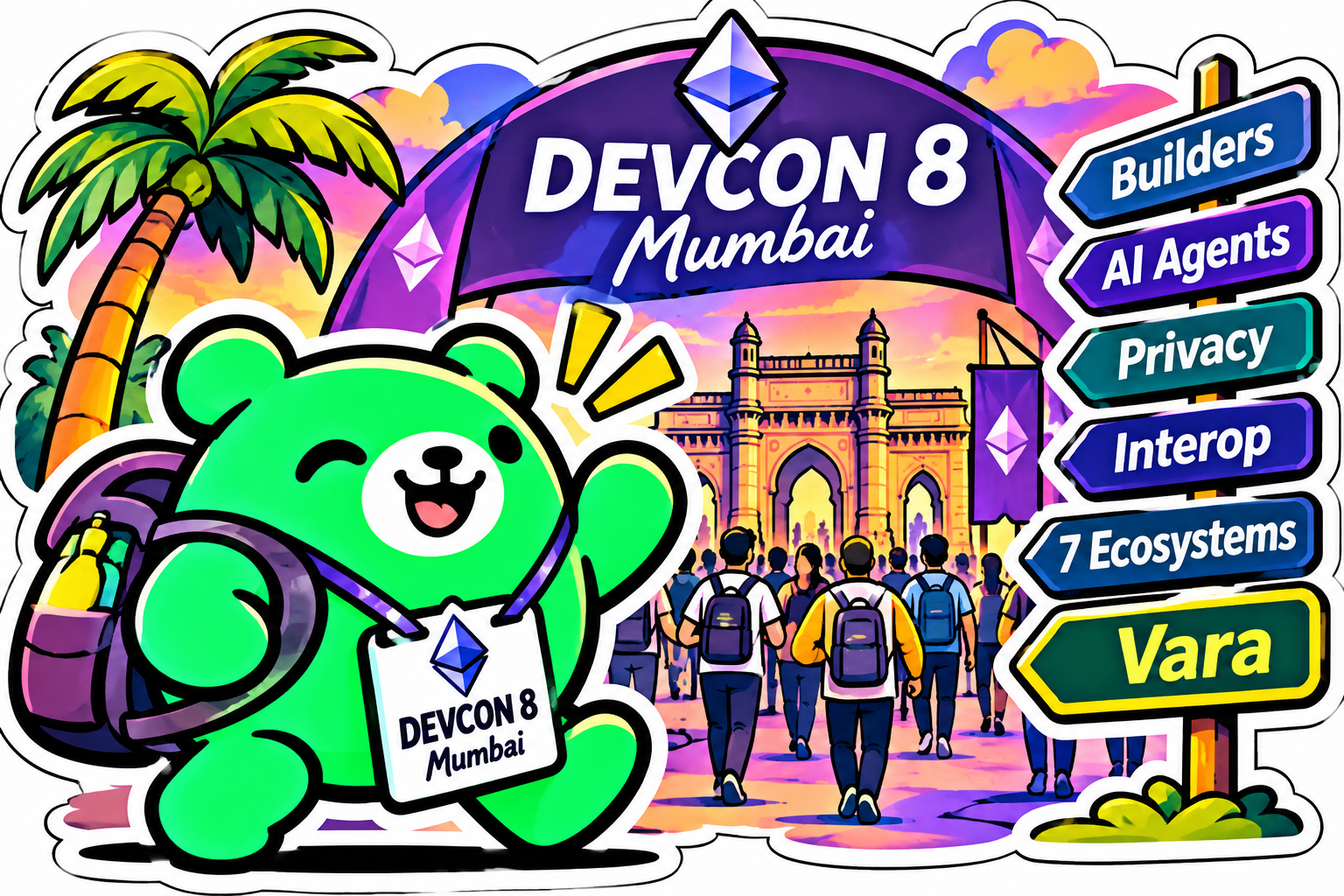
Everybody's going to Mumbai.
Well, not everybody. But if you're building something interesting in blockchain right now, there's a pretty good chance somebody you want to talk to will be there.
Devcon 8 kicks off November 3 at Mumbai's Jio World Centre, bringing Ethereum's developer community together for four days of research, demonstrations, technical discussions, and the sort of conversations that eventually turn into things people actually use.
Vitalik Buterin will be there, alongside Ethereum Foundation researchers, protocol engineers, security specialists, and developers from across the industry.
The official program covers everything from core protocol development and cryptography to privacy, governance, and AI agents.
But here's what caught this particular green bear's attention.
The interesting stuff isn't confined to Ethereum.
A collection of other technology ecosystems is gathering around Devcon week, each bringing its own ideas about where decentralized computing goes next.
And one of them is Vara.
Seven ecosystems walk into Mumbai...
There's an old joke about how many blockchain developers it takes to change a lightbulb.
Nobody knows. They're still arguing about which chain should record the transaction.
Fortunately, some folks in India have a better idea: get everybody in the same city and see what happens.
Local organizer Builder Base is promoting a series of seven events spanning seven technology ecosystems during Devcon week.
And it's a fascinating mix.
Claude and Cerebras represent two sides of the AI revolution: intelligent software and the computing infrastructure needed to run it.
Monad brings its high-performance, Ethereum-compatible blockchain architecture.
Zcash represents privacy-preserving cryptocurrency and zero-knowledge technology.
HashKey brings digital-asset infrastructure and broader Web3 development.
Polkadot brings its approach to connecting blockchain networks and building shared infrastructure.
And Vara brings an execution architecture built around persistent programs, asynchronous communication, and WebAssembly.
Seven ecosystems. Seven different approaches to some of the biggest problems in decentralized technology.
AI. Privacy. Performance. Interoperability. Application execution.
That's a pretty good snapshot of where the industry is heading.
And it's a considerably more interesting conversation than arguing about which token has the prettiest chart.
So what exactly does Vara bring to the party?
Here's where things get good.
Most blockchains are designed around transactions. Somebody submits a transaction, the network processes it, and the resulting state gets recorded.
That works wonderfully for plenty of applications.
But it isn't necessarily the most natural model for software that needs to remain active, respond to messages, coordinate with other programs, or manage complicated operations over time.
Vara approaches application execution differently.
Built on Gear Protocol, Vara uses WebAssembly and an actor-model architecture in which programs maintain their own state and communicate through asynchronous messages.
Think of it less like repeatedly calling a calculator and more like having a collection of independent software components that can receive instructions, do work, and communicate with one another.
That opens up some interesting possibilities.
Games with persistent worlds.
Applications coordinating complicated workflows.
Financial systems responding to changing conditions.
And autonomous software agents interacting with other programs without a human manually initiating every individual step.
These aren't random examples pulled from a blockchain marketing deck. They're exactly the kinds of applications developers are increasingly trying to build.
And they fit neatly into the conversations happening around Devcon.
Vara.eth: Bringing Gear's execution model to Ethereum
Here's where Vara's presence around an Ethereum conference becomes especially relevant.
Vara.eth is designed to bring Gear's execution architecture into Ethereum's ecosystem.
Rather than asking Ethereum developers to abandon their existing tools and infrastructure, Vara.eth offers a way to run WASM programs using Gear's runtime while anchoring their state commitments to Ethereum.
Its architecture uses Ethereum contracts to register and represent programs, with specialized executors running those programs and submitting validated state transitions back to Ethereum.
In plain English?
Let specialized infrastructure handle sophisticated application execution while Ethereum provides the settlement and verification layer.
That's an interesting proposition for developers building applications that need more sophisticated execution than conventional smart contracts comfortably provide.
Ethereum has an enormous developer community, established tooling, and years of accumulated infrastructure.
Gear brings an execution model designed for persistent programs, asynchronous communication, and complex application logic.
The interesting question isn't which one replaces the other.
It's what developers can accomplish by combining their strengths.
And Mumbai is full of exactly the sort of people who might want to find out.
AI agents and the case for persistent programs
Everybody is talking about AI agents.
And while the phrase has already been stretched almost beyond recognition by marketing departments, there's a genuinely interesting technical problem underneath all the noise.
How do you give autonomous software the ability to perform useful work across different systems without handing it unlimited authority or depending entirely on centralized services?
Imagine an agent managing resources in a game, coordinating transactions between applications, or executing a complicated workflow over an extended period.
It needs rules, permissions, persistent state, and predictable execution.
And ideally, it shouldn't depend on somebody remembering to keep a server running.
Vara's persistent programs, asynchronous messaging, and scheduled execution capabilities provide useful building blocks for these kinds of applications.
An agent can interact with onchain programs that maintain state, process messages, and carry out predefined logic over time.
That creates opportunities for applications where AI handles decisions while blockchain programs enforce rules and manage assets.
Now put that alongside the AI developers, infrastructure specialists, and Ethereum builders gathering in Mumbai.
You can start to see why Vara belongs in the conversation.
Fortunately, Vara has builders, not just diagrams.
You can have the most elegant architecture in the world, but eventually somebody needs to use it for something.
And Vara's growing application ecosystem has examples worth showing.
Take Polybaskets.
The prediction-market platform recently reported 5,742 indexes created and 877 active traders during its third season.
Vara has also highlighted more than 1,700 ENS subnames claimed through Polybaskets using free, gasless registration.
That last detail deserves some attention.
For years, blockchain developers have expected ordinary users to tolerate a truly remarkable amount of nonsense.
Wallet setup. Gas fees. Cryptic addresses. Transaction confirmations. More wallet setup.
And then we wonder why everybody isn't lining up to use our revolutionary technology.
Making recognizable identities available without asking users to pay for every little interaction is exactly the sort of improvement that makes blockchain applications more approachable.
Meanwhile, AANTV has been developing a browser-based environment for building on Vara, currently in beta.
Tools like that help shorten the distance between somebody having an idea and actually building it.
And projects such as Tokenator and RivrDEX are making token creation and decentralized trading more accessible.
Including, yes, a certain green bear who has been known to experiment with these things himself.
Disclosure: The operator of UseVara.org created VBEAR, a community token listed on RivrDEX. UseVara is an independent publication and is not affiliated with the Vara or Gear foundations.
These projects demonstrate different sides of the same opportunity: applications that take advantage of Vara's architecture while making blockchain technology easier to use.
That's a much better starting point for a conversation with developers than a slide deck full of hypothetical use cases.
VARA [OFFSTAGE]: Less theater, more building.
On November 4, Vara is hosting VARA [OFFSTAGE], an invite-only gathering organized around Devcon week.
The announced program includes live demonstrations, short presentations, community spotlights, and a fireside discussion with builders.
One detail I particularly like is that the fireside conversation is supposed to address early users and decisions that didn't go according to plan.
Excellent.
More of that, please.
We've all heard enough presentations about frictionless, revolutionary, paradigm-shifting infrastructure to last several lifetimes.
Tell us what you built.
Tell us what people actually used.
Tell us what broke.
And tell us what you're doing differently because of it.
That's the kind of conversation that makes developer events valuable.
Community partners include Krew3, Lucknow DAO, and Builder Base, with registration handled through Luma.
For a growing ecosystem, meaningful conversations with interested developers can be far more useful than trying to impress an auditorium.
Especially if those conversations lead to somebody building something afterward.
India isn't new territory for Vara.
Vara's presence in India didn't materialize overnight because Devcon happened to be in Mumbai.
The network has previously highlighted Indian ambassadors, including Shashwat and Prashant, who have also been helping promote the OFFSTAGE gathering.
That existing community connection is worth recognizing.
Major conferences generate enormous bursts of attention.
Then everybody flies home.
The communities that remain are the ones that turn a week of introductions into something lasting.
India has an enormous software development population, active Web3 communities, and no shortage of people capable of building sophisticated applications.
Devcon provides the occasion.
Local developers and community organizers provide the continuity.
The real measure of success won't be how many people attend an event.
It'll be whether any of those people are still building with Vara six months from now.
What we're watching during Devcon week
Devcon 8 runs November 3–6 at the Jio World Centre in Mumbai.
For Vara, several developments will be particularly interesting to follow.
The seven-ecosystem events: Builder Base's gathering creates opportunities for developers from different technical communities to meet and exchange ideas.
Vara.eth: Will Ethereum developers show interest in Gear's execution architecture? Will there be new technical demonstrations, integrations, or development announcements?
VARA [OFFSTAGE] on November 4: What do the participating builders demonstrate? What lessons do they share? And do any new collaborations emerge?
The application ecosystem: Will projects such as Polybaskets, AANTV, and other Vara builders have new developments to share during the week?
The longer-term picture: Can Vara turn exposure to Ethereum's developer community into actual development activity?
UseVara will be following the public announcements, community discussions, technical updates, and ecosystem news throughout the week.
And we'll be particularly interested in what gets built after the conference is over.
Seven ecosystems. A whole lot of possibilities.
For years, blockchain ecosystems have spent an extraordinary amount of energy trying to convince everyone that their particular network should be the center of the universe.
Our chain is faster.
Our chain is cheaper.
Our chain is more decentralized.
Our mascot could beat up your mascot.
Okay, that last one might just be me.
But the future of decentralized computing probably isn't going to be built by one network doing absolutely everything.
Ethereum has its strengths.
Polkadot has its strengths.
Privacy networks, AI infrastructure providers, and specialized execution platforms all bring different capabilities to the table.
And Vara has a genuinely interesting contribution to make through Gear's execution architecture.
The opportunity isn't to convince every Ethereum developer to abandon what they're doing.
It's to show them something they couldn't easily do before.
Something that makes their applications better.
Something that removes friction.
Something that turns a complicated technical possibility into a product somebody actually wants to use.
Vara doesn't need to steal Ethereum's spotlight. It needs to give Ethereum's builders something worth taking home.
That's what we'll be watching.
Throughout Devcon week, UseVara will be following the announcements, technical developments, community updates, and ecosystem news coming out of Mumbai.
Devcon hasn't even started yet.
Let's see what these crazy bastards build.
— Varbear 🐻💚
Sources and further reading
Devcon and the seven ecosystems
Vara and Ethereum
Builders and community