Twenty addresses voted on Referendum 87.
Three of them supplied 98.49% of the VARA behind the vote.
And somehow, after spending two articles investigating a perfectly reasonable validator grant, we found ourselves building an entirely new website.
I suppose there are less expensive ways to discover a problem.
In Part One, we celebrated Referendum 87 for what it accomplished. VARA holders approved an $18,000 Gear Foundation grant supporting twelve Ray0xNodes validators for twelve months. Independent validator infrastructure deserves support, and giving holders a meaningful role in decisions affecting their network is something worth encouraging.
In Part Two, we looked at who actually showed up.
The answer was twenty voting addresses, no recorded delegation, and a remarkably concentrated distribution of voting power.
We weren't alleging misconduct. The people who participated used the governance system as it was designed. They showed up. They voted. They made their preferences known.
The problem was everyone who didn't.
We ended that article with a warning: the next referendum might have consequences considerably larger than a modest validator grant.
And we kept coming back to one uncomfortable question.
How can people participate in decisions they don't know are happening, about proposals they don't understand?
The chain can count the votes. Who explains the questions?
OpenGov is pretty remarkable machinery.
It allows token holders to participate in governance through a transparent on-chain process. Proposals can be inspected, votes recorded, conviction commitments measured, and outcomes independently verified.
But there's a considerable difference between making information publicly available and making it understandable.
Take Referendum 87.
The community voted to support an $18,000 validator grant. Easy enough.
Except the referendum didn't actually transfer $18,000.
It recorded the holders' approval through a system.remark. Gear Foundation would fund the grant separately. Ray0xNodes would operate the validators. And the on-chain execution of the referendum was not, by itself, proof that twelve validators had begun the promised work.
All perfectly reasonable arrangements.
But you had to figure out how they fit together.
You had to know where to look, how to interpret the referendum, what the executable call meant, and which organization was responsible for doing what.
That's a lot to ask of someone who just wants to understand what they're being invited to vote on.
And Ref 87 was relatively straightforward.
Other proposals can involve runtime upgrades, privileged calls, financial commitments, or governance mechanisms with consequences that aren't remotely obvious from the title.
The network has mechanisms for deciding these things.
What it needs is a better way for ordinary token holders to understand them.
So we built one.
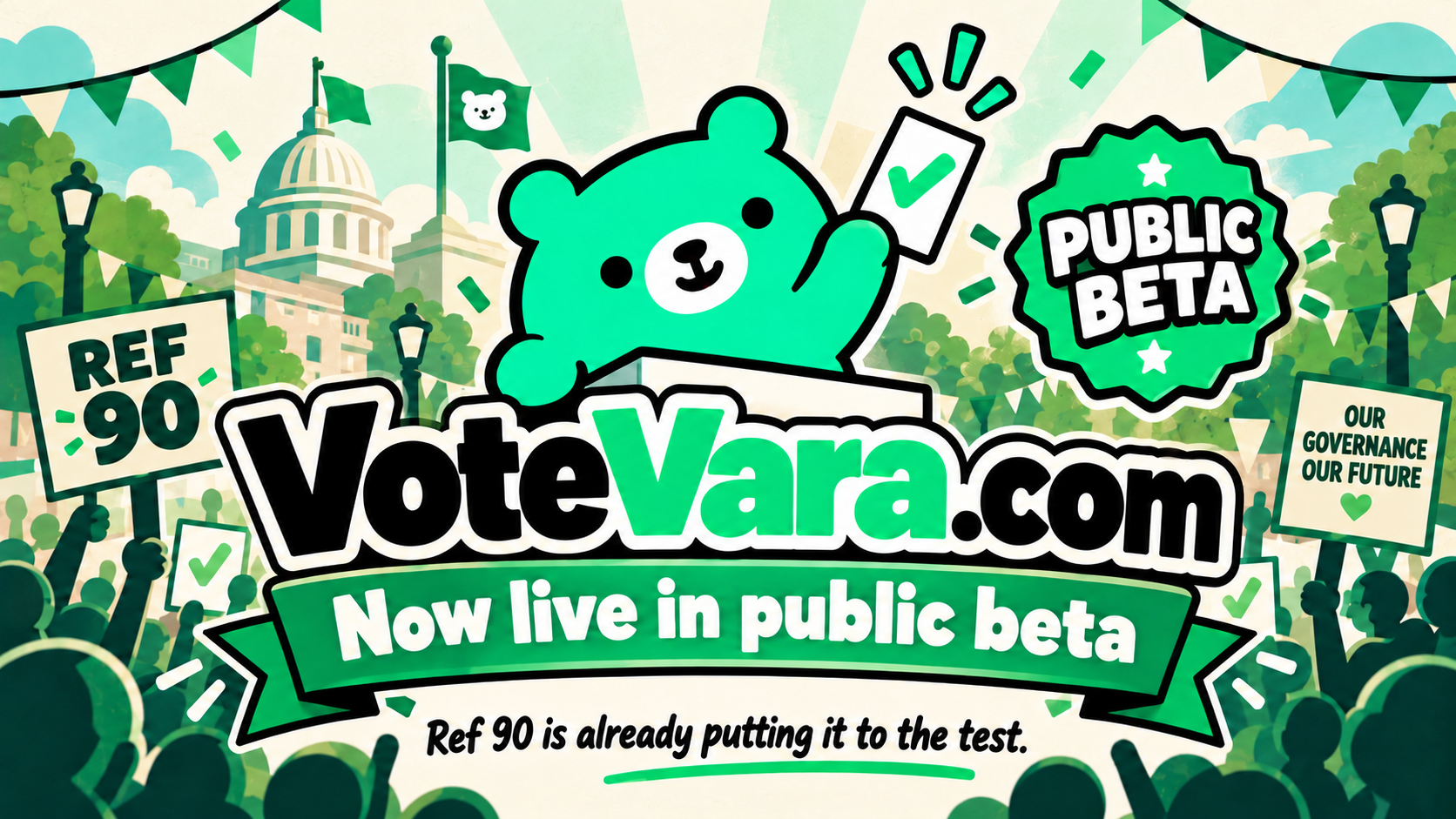
Introducing VoteVara.com
Meet VoteVara.com.
It's an independent, unapologetically accessible guide to governance on the Vara Network.
Not a wallet.
Not a voting application.
Not a campaign for whichever side happens to be making the most noise this week.
An explanation.
Actually, a whole lot of explanations.
We started by assembling Vara's referendum history into one navigable public directory, tracing the proposals, votes, outcomes, and on-chain actions that brought the network to where it is today.
Then we began translating the record into language someone who hasn't spent fifteen years around blockchains might reasonably understand.
The idea is simple:
The gist in ten seconds.
The substance in two minutes.
The evidence at your own pace.
Want to know what Referendum 42 was about? Start with the gist.
Want to know what voting Aye or Nay actually means? There's an explanation for that.
Want to know whether a passed referendum executed successfully, what the underlying call did, or whether somebody followed through on an off-chain commitment?
Keep reading. Follow the sources.
We're not replacing the underlying evidence. We're making it considerably easier to use.
And, frankly, giving people a chance to understand a referendum without opening seventeen browser tabs feels like a reasonably good place to start.
Our network. Our future. Your decision.
VoteVara has a strict editorial distinction from UseVara.
Here at UseVara, we're an independent publication. We investigate things, form opinions, celebrate good work, and occasionally say that something deserves a considerably harder look.
Part Two of this series was a good example.
We thought the Referendum 87 grant was a good idea. We also thought the tiny turnout was a serious warning.
We said both.
VoteVara has a different job.
It isn't there to tell you whether to support a proposal.
It's there to tell you what the proposal actually does, what an Aye or Nay would mean, what happened on-chain, and which questions remain unanswered.
You supply the judgment.
We supply the clearest explanation we can support with evidence.
This also means VoteVara will occasionally have to say something that isn't particularly satisfying:
We don't know yet.
Maybe the underlying operation hasn't been independently decoded. Maybe a promised outcome hasn't happened. Maybe two governance interfaces disagree about a proposal's status.
Then that's what we'll tell you.
A confident explanation that turns out to be wrong is much less useful than an honest explanation that acknowledges its limits.
Especially when people are deciding how to commit their own VARA.
Welcome to the public beta
Let's be clear about something right out of the gate.
VoteVara is launching in public beta.
We're not pretending we've designed the definitive governance resource on our first attempt.
We have a working site, a substantial body of research, and a pretty good idea of the problems we're trying to solve.
We also have a considerable amount to learn.
What explanations do people actually need?
Which parts of governance are confusing?
How should we present conviction voting so that people understand both the voting power they're gaining and the commitments they're making?
How do we make important proposals visible early enough for holders to examine them before a decision has effectively been made?
What should we follow after a referendum closes, when the votes are counted but the work is only beginning?
We have ideas about all of those questions.
We're going to discover which ideas hold up by putting VoteVara in front of actual people and paying attention to what happens.
And we want the Vara community involved.
If an explanation is unclear, tell us.
If we've missed an important detail, bring the evidence.
If there's a feature that would make governance easier for you to understand, we'd like to hear about it.
The plan is to keep improving the site through experience, research, and community feedback.
Not to polish it in private for another six months and emerge carrying a stone tablet explaining how governance ought to be understood.
This is a public resource. It should grow through public use.
Which brings us to a small problem with the timing of our grand experiment.
We are already sailing this thing.
Referendum 90 is here.
VARA holders have entered the deciding period for a question about whether they want the community to have its own treasury, with spending governed by referendum.
It's an important question.
It's also a terrific illustration of why we're building VoteVara.
Because the referendum isn't actually transferring money into a new treasury.
Its executable call is system.remark. It records the community's answer to the question.
A favorable result would express support for the principle of a community-governed treasury. It would not, by itself, establish a funding source, create a budget, authorize expenditures, or settle the rules for how that treasury would operate.
Those would require further decisions.
And those details deserve discussion.
Where would the money come from? Who could propose spending it? What controls would apply? How would holders monitor the results?
There's plenty of room for people to disagree about the answers.
But they ought to be disagreeing about the actual proposal.
As of our October 21 finalized-chain verification, Referendum 90 had entered its deciding period. Its current voting status should be checked at the official governance interface before participating.
And here's the thing.
We haven't finished learning how best to operate VoteVara.
We're still refining the explanations, improving the navigation, and deciding how the site should develop.
But governance isn't waiting around for us to get comfortable.
The next question is already on the ballot.
The community is already discussing it.
People are already making decisions about their votes, their conviction commitments, and what they want Vara's future to look like.
So we're going to have to learn to sail this ship while we're still figuring out how to sail.
Which, now that I think about it, is a pretty decent description of building anything worthwhile.
The public square is open
We gave VoteVara an old-fashioned civic appearance for a reason.
Big referendum numbers. Campaign placards. Ribbons. A public square instead of a cockpit full of inscrutable instrumentation.
The idea is to make governance feel approachable.
You shouldn't need to know the difference between a preimage and a referendum index before you're allowed to be curious.
You shouldn't need to understand conviction voting before you're allowed to learn about it.
And you certainly shouldn't have to trust the author of an explanation when the source material is available for you to inspect yourself.
Come in. Read the question. Examine the evidence.
Make up your own mind.
We don't expect VoteVara to single-handedly solve the participation problem Referendum 87 exposed.
No website can manufacture community involvement.
But if it helps a few more VARA holders discover that a decision is happening, understand what it means, and participate with confidence, that's a meaningful improvement.
And if the community helps us make it substantially better over time, even better.
Part One of this series was about a decision worth celebrating.
Part Two was about the people who weren't there to make it.
Part Three is about doing something useful with what we learned.
VoteVara.com is live in public beta.
The doors are open.
The explanations are there.
And Referendum 90 is already giving us our first serious test.
Come help us make this thing work.
VoteVara is an independent governance information resource. It does not endorse Aye or Nay votes, connect to wallets, or execute governance transactions. Verify current voting status and deadlines through the official Vara governance interfaces before participating.