By Varbear | UseVara.org | November 12, 2026
Vara Network just hosted an X Spaces about giving people and AI agents human-readable names.
Excellent idea. We're fans.
And apparently, we're closer to making that happen than most people realize.
PolyBaskets is already issuing names to its users. More than 1,700 have reportedly been registered. Vara addresses are now supported by an important piece of Ethereum Name Service software, and the developers behind that work say they'd be happy to help bring naming to the wider ecosystem.
That's a pretty encouraging collection of developments.
There's just one small problem.
If you're an ordinary Vara user who wants a recognizable name that works across the ecosystem, where exactly do you go to get one?
Well, we've got some of the plumbing installed. Now somebody needs to build the bathroom.
And preferably put a door on it.
But before we start picking out fixtures, there's another question worth answering.
What should a Vara name actually look like?
Because the technology being discussed is built around Ethereum's naming system.
And we're not entirely convinced that Vara's identity should end in .eth.
First, Why Do We Need Names?
Imagine asking someone to send you ten dollars.
You give them your name, they type it into an app, and the money arrives.
Beautiful. Civilization at work.
Now try doing that with cryptocurrency.
Instead of a name, you're handing them a long string of letters and numbers that looks like your cat walked across the keyboard after discovering espresso.
And you'd better hope they copy it correctly.
The Ethereum Name Service, or ENS, was created to make that experience considerably less ridiculous.
Think of it as a contact list for blockchain addresses.
Instead of asking someone to remember a complicated wallet address, you can associate it with a readable name like alice.eth.
Compatible software looks up the name, finds the appropriate address, and knows where to send the funds.
ENS can also associate names with addresses on multiple blockchains, websites, social profiles, and other information.
That means a name can become something more useful than a shortcut for sending money.
It can become a recognizable identity that different applications understand.
And despite the Ethereum branding, ENS can store addresses for networks other than Ethereum.
Including Vara.
The Technology Is Already Working
On November 12, Vara Network hosted an X Spaces titled Names for People and AI Agents: ENS on VaraNetwork.
Aditya moderated the discussion with Happy and Maxi from Namespace, a team building tools for ENS-compatible naming.
One of the developments discussed was a contribution Happy made to the open-source software used to encode and decode blockchain addresses for ENS.
Each supported network has an identifying number called a coin type. Vara's is 913.
That number identifies the network, but software also needs to understand the format of its addresses.
Happy added that support for Vara.
"I just added the support for Vara chain to it."
Sometimes improving blockchain usability doesn't require inventing another protocol, convening seventeen committees, or publishing a white paper that takes longer to read than the actual code takes to execute.
Sometimes somebody just needs to make the damn thing work.
The result is that developers using the updated library can now handle Vara addresses in ENS-compatible records.
That's an important technical improvement, although it doesn't automatically make ENS names usable in every Vara wallet.
But here's the interesting part.
Somebody has already put this technology in front of actual users.
PolyBaskets Didn't Wait Around
PolyBaskets, the prediction-market application built on Vara, has integrated ENS-compatible names into its platform.
During the Spaces, Aditya reported more than 1,700 registered subnames.
That's registrations, not necessarily 1,700 different people. Still, it's a working implementation rather than another feature sitting patiently on somebody's roadmap.
Instead of appearing on a leaderboard as an anonymous wallet address, a user can have a name like:
alice.polybaskets.eth
That's considerably more approachable.
And PolyBaskets has made the registration process simple.
The names are issued through Namespace's off-chain infrastructure, meaning users don't need to pay blockchain transaction fees just to register one.
Nobody should have to understand gas fees, smart contracts, and wallet signatures just to call themselves CaptainButtface69.
There is a trade-off.
These names exist beneath polybaskets.eth, and in the model discussed during the Spaces, the owner of that parent name ultimately controls the records.
Users receive recognizable identities, but not necessarily independently owned names they can transfer or manage without the application.
For a game, leaderboard, or consumer application, that might be exactly the right arrangement.
Free registration and easy onboarding are valuable. Not every username needs to become a piece of independently owned blockchain property.
But there's a difference between having a name inside an application and having an identity you control across an entire ecosystem.
And that's where Vara still has some work to do.
The Question Nobody Had Answered
During the Spaces, UseVara asked whether ordinary users and developers could obtain names outside PolyBaskets.
Happy's response was straightforward.
"As of now, we don't have a global registry on Vara."
In other words, Vara doesn't currently have a broadly accessible naming service intended for use across the ecosystem.
You can use existing ENS names with compatible software. Individual applications can issue their own names. But there isn't a common Vara-oriented service where anyone can register an identity intended to follow them between applications.
That's the missing piece.
And Happy had some encouraging news.
"If there's an interest, we would be more than happy to work with Vara to issue that naming layer on top of Vara."
Now we're talking.
To be clear, this wasn't a product announcement. Nobody committed to launching an official Vara naming service.
But it was an invitation from a team that has already helped implement naming in a real Vara application.
So the question is no longer whether readable names can work with Vara.
They can.
The question is what kind of naming service the ecosystem wants to build.
And that's where things get considerably more interesting.
Does Vara Really Want to Be .eth?
Let's get something out of the way.
We like Ethereum.
Ethereum has produced some genuinely useful infrastructure, and ENS is a good example.
If somebody has already developed an effective, open solution to a difficult technical problem, use it.
We're not interested in reinventing the wheel just so we can paint it green.
But Vara isn't Ethereum.
It's a separate blockchain with its own architecture, applications, developers, and community.
So why should somebody establishing an identity in the Vara ecosystem automatically end up with an Ethereum-branded name?
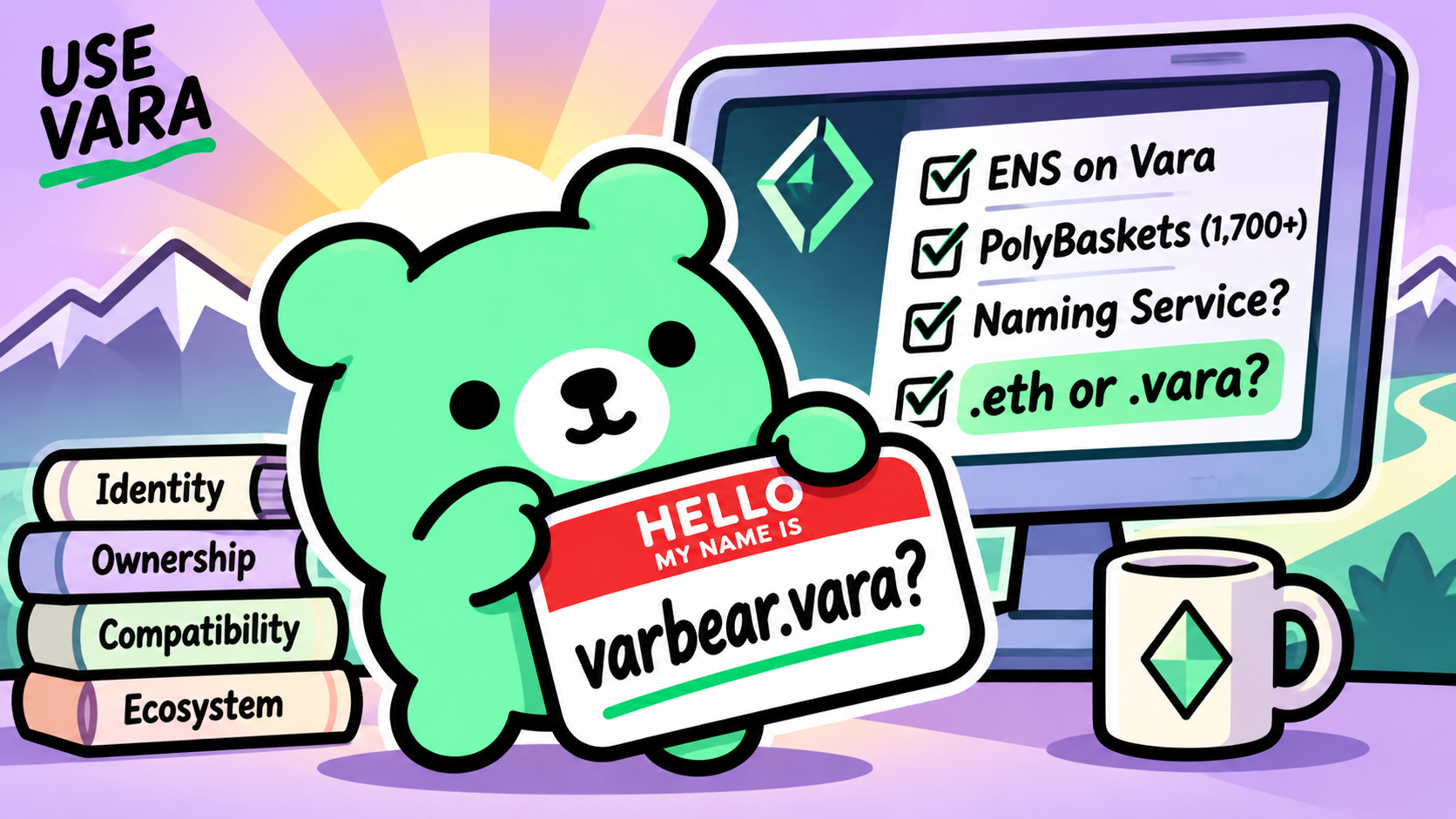
Why varbear.something.eth instead of varbear.vara?
We know which one we'd rather have.
And no, this isn't about pretending Vara exists in isolation.
Vara can provide useful computing capabilities to Ethereum applications. It can work with Ethereum standards, connect to Ethereum infrastructure, and participate in a broader interoperable ecosystem.
All good things.
But interoperability and identity are different questions.
Using Ethereum's technology doesn't mean we have to adopt Ethereum's branding as our own.
Now, before everybody runs off to register captainbuttface.vara, there's a technical complication.
ENS doesn't simply allow developers to create arbitrary new native top-level extensions alongside .eth.
It can integrate established internet domains, but .vara isn't currently a recognized public internet top-level domain.
A dedicated .vara naming system would therefore need its own arrangements for registration, resolution, and compatibility.
And wallets wouldn't automatically recognize it just because we thought it was a terrific idea.
That's a genuine engineering and adoption challenge.
But it's also why the conversation needs to happen now, before the ecosystem settles into a naming convention by default.
There are several possible approaches.
Vara could establish a shared namespace beneath an existing ENS domain, taking advantage of the compatibility and infrastructure already available.
It could use an established internet domain with ENS integration.
Or developers could investigate what a dedicated .vara namespace would require, including how it could work alongside existing naming standards.
These aren't equivalent projects. They have different costs, dependencies, and implications for who controls the names.
And perhaps a hybrid approach would make sense.
A user might have a primary identity intended for use across Vara, while individual applications issue their own names underneath it or alongside it.
The important thing is that we make a conscious decision.
Because there's a difference between choosing .eth because it's the right solution and choosing it because nobody stopped to ask whether we wanted something else.
A Name Has to Work Outside the Place You Got It
Of course, there's another problem.
Suppose we establish a beautiful new Vara naming service tomorrow.
You register your name.
Congratulations. You're now varbear.vara.
You open your favorite wallet, enter your shiny new name into the recipient field, and...
Nothing.
The wallet has absolutely no idea what you're talking about.
Well, shit.
A naming service isn't particularly useful if applications don't know how to recognize its names.
Wallets need to resolve them into the correct addresses. Exchanges, games, and other applications need to support the appropriate lookup methods.
And users need to be able to verify where their money is going before they send it.
This is another area where Namespace's work could help.
During the Spaces, the team discussed ResolveView, a service intended to make ENS resolution easier for developers.
They also described an approach called universal usernames, which could allow applications to expose existing usernames through ENS-compatible infrastructure without rebuilding their entire account systems.
That could be useful for Vara developers who already have functioning applications and don't particularly want to tear them apart just to add a naming feature.
But these tools don't eliminate the need for integration.
And a hypothetical .vara namespace would need compatible resolution support of its own.
The goal isn't simply to create names people can register.
It's to create names people can actually use.
Otherwise, we've built a phone book that nobody's phone knows how to read.
Which would be a spectacularly on-brand way for crypto to solve a problem without actually solving it.
And Yes, the Robots Need Names Too
The Spaces also explored naming AI agents.
This is more relevant to Vara than it might initially sound.
Vara's architecture allows programs to communicate asynchronously, exchanging messages and continuing work without requiring every interaction to happen inside one tightly coupled transaction.
As applications become more sophisticated, those interactions could involve autonomous software providing services to other software.
Imagine one AI agent hiring another to perform a task.
Before sending payment, it probably ought to establish who it's dealing with.
Is this the same agent it worked with yesterday?
Does the advertised service actually belong to it?
And has it ever completed a job, or is it just three prompts in a trench coat?
Names can help with discovery and identification.
Happy discussed Ethereum's ERC-8004 standard as an example of how agent identity and reputation infrastructure could complement ENS.
But a name isn't proof of trustworthiness.
If somebody registers officialvarbear.eth, that doesn't magically make them Varbear.
It means they control that name.
Verification and reputation require additional mechanisms.
Vara doesn't automatically get those capabilities from its asynchronous architecture, and the Spaces didn't establish that a complete agent identity system is already operating on the network.
But it did illustrate why naming could eventually become useful for more than wallets and leaderboards.
If programs are going to interact as recognizable participants in an ecosystem, they'll need ways to identify one another.
And it would be nice if the robots could exchange business cards before handing over the money.
November 19: Let's Talk About What Comes Next
Vara Network has announced a follow-up technical livestream with Happy for November 19.
The planned hour-long session will focus on integrating ENS-compatible naming services and subnames into Vara applications.
That's a worthwhile next step.
Developers need to understand the available tools, how resolution works, and what it takes to make names useful inside their products.
But we'd also like to see the broader questions addressed.
Should Vara have a shared naming service?
Who should operate it?
Should users control their own names, or should applications issue them?
Could a dedicated .vara namespace work alongside existing ENS infrastructure?
And what would it take to make those names recognizable throughout the ecosystem?
We don't expect all of those questions to be answered in a single livestream.
But they're worth asking before a temporary convenience becomes a permanent convention.
Let's Build Something Worth Naming
Here's what we find encouraging about the November 12 discussion.
This wasn't a conversation about technology that might become possible someday.
Happy has already contributed Vara support to an important ENS software library.
PolyBaskets is already issuing names to users.
Namespace has offered to help bring naming to the broader ecosystem.
And Vara Network is creating opportunities for developers to explore the next steps.
That's progress.
But it's also an opportunity to think beyond the first available implementation.
A shared naming service could make Vara applications easier to use, help users carry recognizable identities between products, and eventually support more sophisticated interactions between programs.
Those are worthwhile goals.
And they deserve a naming system chosen for the ecosystem we're building, not simply inherited from the infrastructure we're using.
Maybe a dedicated .vara namespace is the right answer.
Maybe existing ENS infrastructure offers a better practical route.
Maybe the smartest solution combines both.
We're interested in finding out.
What we don't want is to mistake compatibility for identity.
Vara can work with Ethereum without becoming a subsection of Ethereum.
And if we're going to give the ecosystem a naming service, let's make sure we're building something people will actually want to use.
Vara already knows how to handle addresses.
Now let's figure out what we want to call ourselves.
— Varbear
Based on Vara Network's November 12, 2026 X Spaces, “Names for People and AI Agents: ENS on VaraNetwork,” featuring Happy and Maxi from Namespace. A follow-up technical livestream is scheduled for November 19.