The Vara Network has a new window into its blockchain. Shiny. We kicked the tires, followed some transactions, and tracked down a real staking mystery along the way.
By Varbear | November 10, 2026
Block explorers are one of those pieces of blockchain infrastructure that nobody gets particularly excited about until they need one.
Then, suddenly, they’re the most important website on the internet.
A transaction didn’t show up. A smart contract isn’t behaving. Your staking rewards have gone missing. Somebody says a governance vote passed, and you’d like to see the actual numbers rather than take their word for it.
That’s when you want a block explorer that does more than spit out a hash and wish you the best of luck.
Well, Vara has a new one.
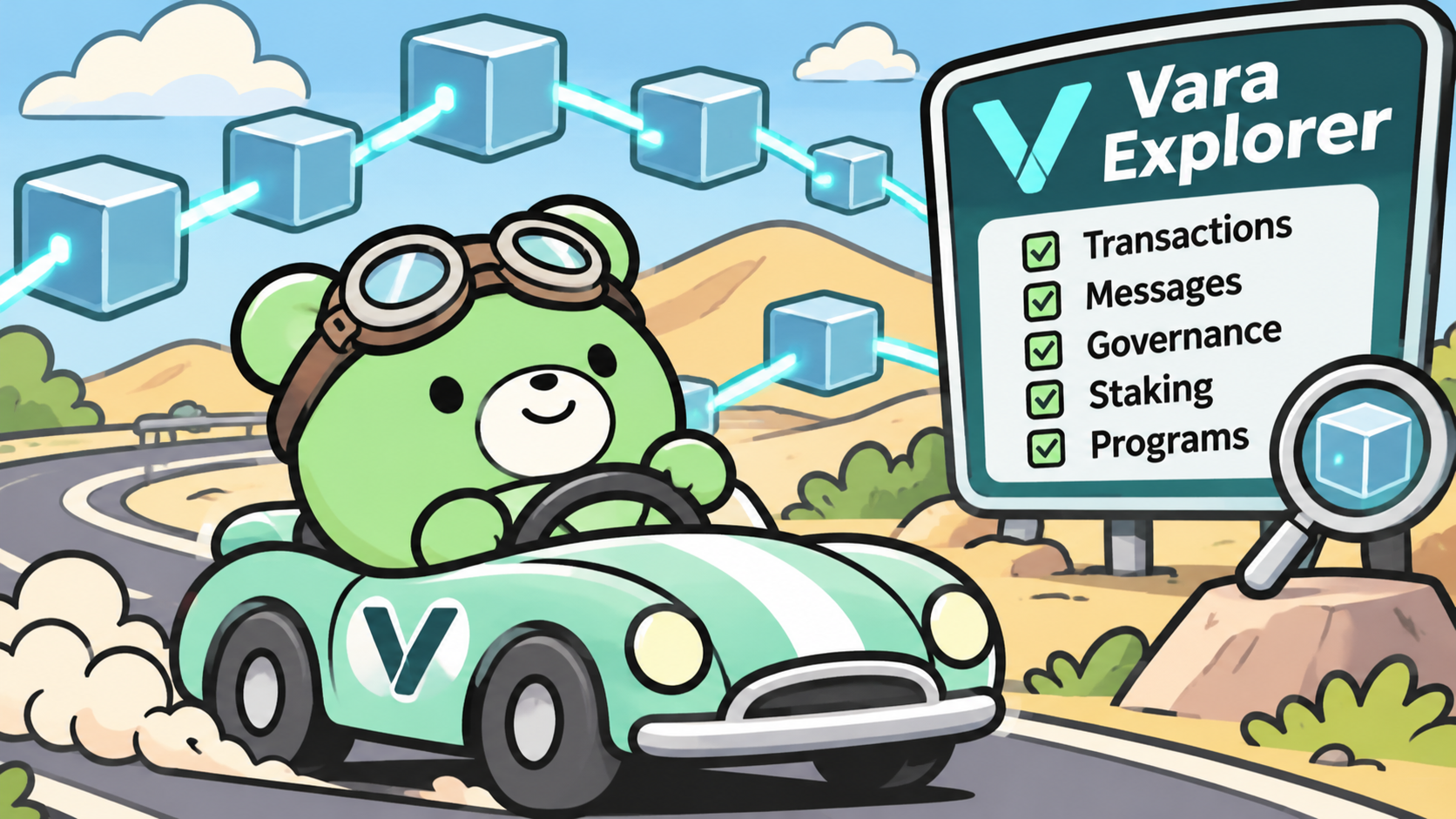
Say hello to Vara Explorer.
And because we aren’t much for believing the marketing copy about new products over here. We decided to take her on a test drive and put her through her paces.
As luck would have it, we had a real blockchain problem waiting for us.
But first, let’s talk about why yet another block explorer is actually a pretty big damn deal for Vara.
Vara Has Some Interesting Machinery Under the Hood
Vara isn’t just another blockchain running the same old execution model with a different logo slapped on it.
Its asynchronous architecture allows smart contracts to communicate through messages, perform work, wait for other operations, and resume execution later.
That’s powerful stuff. It opens the door to applications that behave more like actual software systems instead of collections of isolated transactions.
But it also creates an interesting problem.
When a transaction triggers a series of messages, some of which wait, wake up, and produce additional messages, how do you figure out what actually happened?
On a simpler blockchain, checking whether a transaction succeeded might tell you most of what you need to know.
On Vara, that’s sometimes…a lot of the times, just the beginning of the story.
A good explorer needs to help you follow the conversation.
And that’s where the new Vara Explorer starts getting interesting.
It exposes blocks, transactions, programs, messages, events, validators, staking information, governance activity, and more. It also offers a public API, giving developers another way to inspect what’s happening on the network.
For builders, this means better visibility into what their applications are doing.
For token holders, it means more ways to verify activity rather than relying on whatever a wallet or application happens to display.
For the ecosystem as a whole, it means a little less mystery between pressing a button and understanding what happened afterward.
That’s infrastructure worth having.
All Right, Let’s Kick the Tires
We put Vara Explorer through two rounds of independent testing.
Not just clicking around and declaring everything beautiful because the pages loaded. We checked actual records against Vara’s on-chain data, including historical archive records where necessary.
We looked at governance, staking, Gear messages, VFT contracts, RivrDEX activity, vouchers, historical charts, and the public API.
The first audit involved 19 bounded tests. The follow-up pushed deeper into contract inspection and a real staking investigation.
And the results?
Pretty damn encouraging.
Following a RivrDEX Swap Through the Machine
One of the best demonstrations came from tracing an actual VARA/USDT swap on RivrDEX.
Explorer let us follow the operation through the asynchronous message lifecycle: queued messages, waiting, waking, waiting again, waking again, and finally a successful reply and dispatch.
That’s the kind of visibility Vara needs.
The message payload matched the actual chain data, and we could independently verify the successful execution event.
Now, this wasn’t a magical X-ray into every internal instruction the contract executed. There are still limits to how much of the underlying application behavior Explorer explains.
But being able to follow a real swap through the message system is a meaningful capability.
If you’re building applications on an asynchronous blockchain, understanding the message lifecycle isn’t some obscure developer luxury.
It’s how you figure out what the hell your software is doing.
Governance Without the Guesswork
We also checked Explorer’s reporting for Referendum #90, Vara’s community treasury proposal.
The referendum status was correct. The approval block was correct. And the vote totals reconciled against historical on-chain records.
The audit independently confirmed approximately 10.36 million VARA in raw Aye voting capital, with no Nay votes.
There is room to improve how Explorer presents governance information, particularly the distinction between raw voting capital and conviction-weighted voting power. A readable voter register and export would also make deeper analysis easier.
But the underlying numbers checked out.
And that’s the important starting point.
If we’re going to ask token holders to participate in governance, they ought to be able to inspect the results themselves.
Also, side note, we’re getting a treasury.
VFTs: Following the Contract
We also put VBEAR, our favorite little green troublemaker’s community token, through its paces.
Also, BUY VBEAR! JK, you don’t need to do that. But you can. And if you do you can follow the entire shebang inside Vara Explorer.
Vara Explorer successfully located the contract and displayed its message activity. We independently queried the program’s metadata, confirmed its reported one-billion-token supply and 18-decimal configuration, and checked sampled transfer events against historical chain records.
Explorer indexed 85 outgoing messages, including 56 transfer events. The sampled records matched the blockchain.
That’s a solid result for VFT visibility, particularly on a network where token activity runs through Gear programs and asynchronous messages.
Richer token analytics could be useful down the road, but the underlying contract inspection passed our tests.
And Then My Staking Rewards Went Missing
Now for the fun part.
As it happens, while we were putting Vara Explorer through its paces, I had a little blockchain mystery of my own.
Daily staking rewards from SubWallet Official 03, nomination pool #62, had stopped showing up.
The pool was still there. My stake was still there. Everything looked perfectly normal, except for the rather conspicuous absence of the thing I was supposed to be earning.
(Insert comment about expletive with my money is like expletive with my emotions.)
Well, hell.
If you’re going to test-drive a brand-new block explorer, you might as well give it an actual blockchain problem to solve.
So we went looking.
First, we used Explorer to examine the pool’s activity, staking relationships, and reward transactions.
We found the last reward credit to the pool on November 1 and the last member reward payment and compounding transaction on November 2.
That immediately gave us something useful: a specific point in the transaction history where the expected activity stopped.
Next came the obvious questions.
Had the pool stopped nominating a productive validator?
Nope.
Had the validator stopped earning rewards?
Nope.
Had the pool been closed, or had something happened to the member’s bonded position?
Nope and nope.
The trail pointed further upstream.
Using historical Vara chain records to extend what Explorer showed us, we established that the nominated validator had continued earning rewards across 16 completed eras, but the payout transactions needed to collect those rewards hadn’t been submitted.
The rewards were being earned. They simply weren’t making their way into the pool’s reward account, where they could become claimable by members.
Even more interesting, the account that had previously submitted those payout transactions showed no subsequent transaction activity, despite retaining enough VARA to pay transaction fees.
We couldn’t determine from blockchain data why the submissions stopped. That could be an operational or software issue, and assigning blame without evidence would be silly.
But we could establish where the process had stopped.
That’s a very different situation from staring at a wallet, wondering where your rewards went, and hoping somebody eventually answers a support ticket.
We had a diagnosis supported by on-chain evidence.
And a shiny new Explorer had helped us get there.
That’s What a Block Explorer Is For
This is where the product becomes more than a collection of nicely formatted blockchain records.
We had a real problem involving real funds.
Explorer let us inspect the relevant accounts, identify the pool’s reward history, and locate the last successful transactions.
For the final diagnosis, we still needed historical RPC queries to examine validator reward exposure and unclaimed payout eras.
That’s an area where Explorer could improve: connecting the dots between a pool member, the pool’s reward account, and the validator’s outstanding payouts.
But the fact that we could use the new interface to begin a legitimate financial investigation, then verify the conclusion against the blockchain itself?
That’s a hell of a useful first outing.
And it demonstrates something important about transparent networks.
The blockchain doesn’t just record that something happened.
With the right tools, it can help you figure out why something didn’t happen.
So, What’s the Report Card?
Across our testing, Vara Explorer performed well where the fundamentals matter most.
What impressed us:
- Asynchronous message tracing. Following a real RivrDEX swap through its queue, wait, wake, and reply lifecycle was the standout capability.
- On-chain accuracy. The governance, staking, transaction, and message records we sampled reconciled with the underlying chain.
- Contract-level inspection. We could identify VBEAR and RivrDEX programs using their actual contract addresses and inspect relevant activity.
- A usable public API. Explorer exposes structured endpoints that could support other ecosystem applications and research tools.
- Practical troubleshooting. The nomination-pool investigation demonstrated that Explorer is already useful beyond routine transaction lookups.
What could use another pass:
The governance interface would benefit from clearer voting-power labels, accessible voter records, and better referendum descriptions.
The staking experience could do more to connect validator payouts with nomination-pool rewards, particularly when those payouts are outstanding.
We also encountered compatibility limitations with a published legacy RivrDEX Sails interface definition, and some program metadata wasn’t as complete as the on-chain records would allow.
These are concrete improvements, not reasons to dismiss the product.
A block explorer should first and foremost help people inspect the blockchain accurately.
The evidence says this one is doing that.
The Bigger Picture
Vara has been steadily accumulating the pieces of a more usable ecosystem.
Applications people can actually interact with. Tokens people can create and exchange. Governance that token holders can participate in. Infrastructure that helps developers build without having to reinvent everything from scratch.
A capable block explorer belongs in that foundation.
It doesn’t have the immediate excitement of a new game, a token launch, or a DEX going live.
But when something breaks, when a transaction behaves unexpectedly, or when somebody wants to verify a claim, it’s the infrastructure that makes everything else easier to understand.
And for Vara, where asynchronous messages are fundamental to how applications operate, that visibility is particularly valuable.
We came into this audit wanting to know whether the new Explorer could accurately show us what was happening on the network.
We came out of it having traced a real DEX swap, verified governance results, inspected VFT activity, and tracked down the upstream cause of an actual staking-payment interruption.
Not a bad test drive. If I wore hats I would tip mine.
Welcome to the ecosystem, Vara Explorer.
We kicked the tires.
The wheels stayed on.
And we actually got somewhere.
Let’s go, Vara.
Explore it yourself: Vara Explorer · Referendum #90 · VBEAR contract