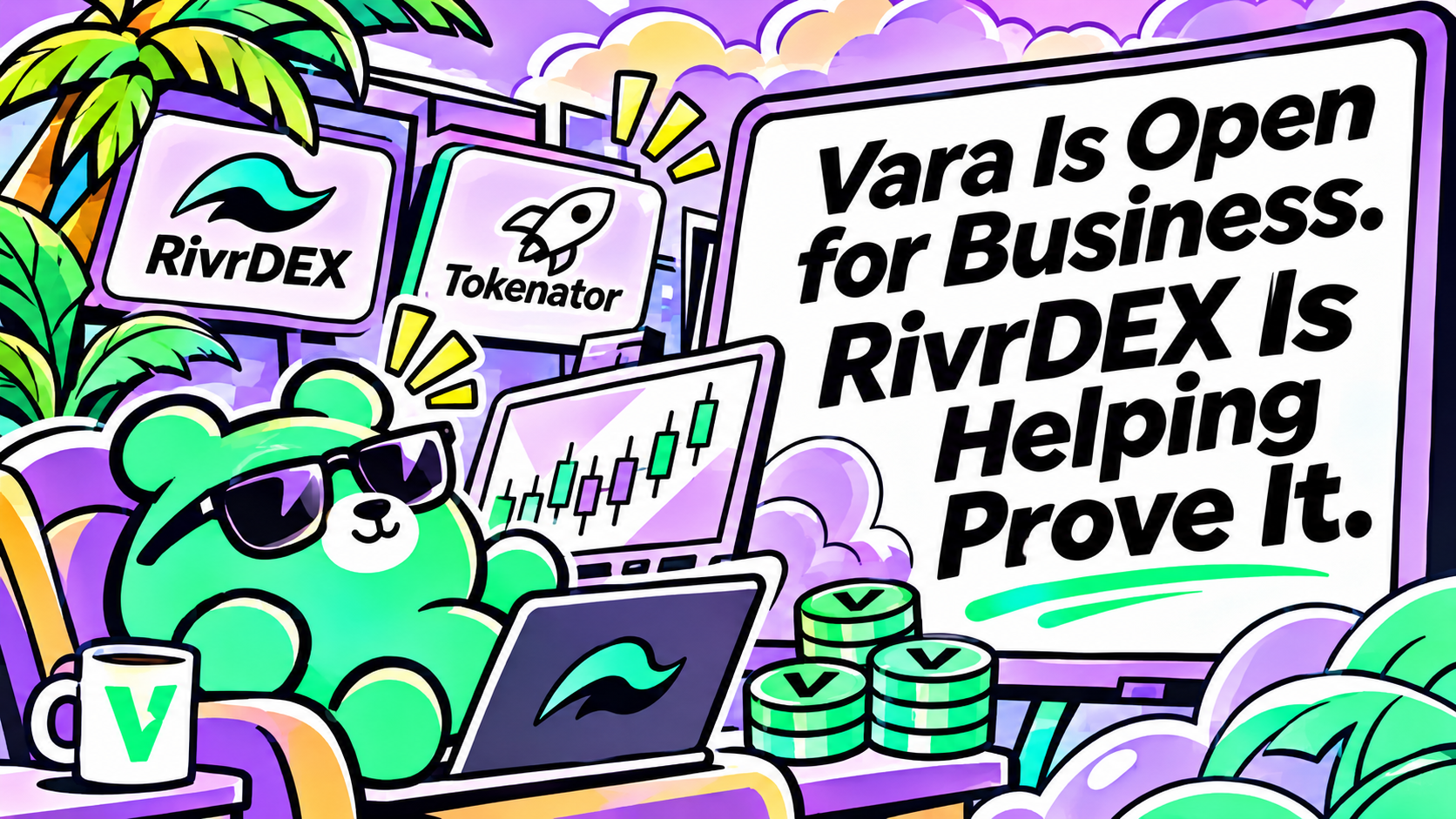
Gas fees you barely notice, 1,400 would-be ambassadors, a new Tokenator launchpad, and a Gear Foundation executive practically begging people to build something. There's a lot happening on Vara, and RivrDEX is right in the thick of it.
Blockchain has spent the better part of a decade promising to change the world.
Faster transactions! Cheaper transactions! Revolutionary architecture! A thousand different ways to move imaginary internet money around while explaining why the next upgrade is going to change absolutely everything.
And look, some of that technology really is impressive.
Vara, for example, has an asynchronous execution model, persistent memory, and a WebAssembly-based architecture that can do some genuinely clever things.
But you know what's even more impressive?
When somebody builds something with it that regular people can actually use.
Enter RivrDEX.
On November 3, RivrDEX head of marketing Irina hosted an X Space with Luis Ramirez, Chief Growth Officer at Gear Foundation, and a collection of RivrDEX ambassadors from around the world.
The conversation covered Vara's technology, community growth, developer tools, governance, AI agents, and a pretty juicy announcement about Tokenator.
And somewhere between the Rust programming lessons and the ambassador introductions, a picture started emerging.
Vara isn't just talking about what it could become anymore.
People are building the damn thing.
RivrDEX: Less Crypto Nonsense, More Actually Trading
RivrDEX is a permissionless decentralized exchange running on Vara Network.
Connect your wallet. Swap tokens. Provide liquidity. Launch a token.
No account registration. No KYC. No asking a centralized exchange whether you're allowed to play with your own money.
So far, so DeFi.
But RivrDEX has a few tricks that make the experience considerably less annoying than what many crypto users have come to accept as normal.
Transactions settle in seconds, and gas fees are so low they're practically a rounding error.
And here's the fun part.
RivrDEX can cover the gas for your first swap.
You can show up without a single VARA token in your wallet and still make your first trade, provided you've got something to trade.
Think about how ridiculous the usual arrangement is.
You discover a new blockchain. You find an application you want to try. You connect your wallet.
And then somebody tells you that before you can do anything, you need to acquire a special token to pay for the privilege of using the special token system.
It's like showing up at a restaurant and being told you need to visit a different restaurant first to purchase the right kind of fork.
Vara's voucher system allows applications to sponsor transaction fees, and RivrDEX has put that capability directly into its onboarding experience.
That's not some revolutionary new financial instrument.
It's just good product design.
And frankly, crypto could use a hell of a lot more of it.
Building on Vara Isn't All Sunshine and Rainbows
Irina also offered something refreshingly rare in a crypto conversation: an acknowledgment that building on a newer blockchain comes with challenges.
Vara isn't Ethereum.
Its smart contracts use Rust rather than Solidity, and its asynchronous messaging model requires developers to think differently about how applications communicate.
Ethereum developers have years of tooling, examples, and existing code to lean on.
Vara developers have a younger ecosystem, fewer examples, and a different architectural approach to learn.
That's real friction.
But there's an upside.
On Ethereum, developers frequently have to ask whether a particular interaction is worth the gas it consumes.
On Vara, transaction costs are low enough that developers can spend more time asking a considerably better question:
What's the best way for the user to experience this?
That's the sort of trade-off worth making.
Because nobody ever fell in love with an application because its developer saved 14 lines of Solidity.
1,400 People Applied to Be Ambassadors. Fifteen Got In.
RivrDEX's first ambassador program attracted more than 1,400 applications.
They selected 15.
That's roughly a one-percent acceptance rate, which is either a pretty impressive level of interest or evidence that crypto people really enjoy filling out applications.
Probably a little of both.
But what caught my attention wasn't the number.
It was what the ambassadors actually talked about.
Sabir Ahmed, joining from Bangladesh, described helping people complete their first swaps and add liquidity. Some came back afterward to tell him it was easier than they'd expected.
Ryan, a Web3 content creator, talked about discovering Vara while looking for blockchains doing something different from Ethereum. RivrDEX stood out because it was an actual application he could use, rather than another elaborate diagram explaining what might someday be possible.
And Teggy, from Nigeria, described his role as translating all the technical blockchain gibberish into something ordinary people can understand.
Bless that man.
Because if there's one thing crypto has never lacked, it's people who can explain the revolutionary implications of a consensus mechanism for 45 minutes without telling you what the hell you're supposed to do with it.
Irina noted that the ambassadors had independently gravitated toward tutorials, walkthroughs, and helping newcomers get started.
That's exactly the kind of community activity an emerging ecosystem needs.
Not another thousand people shouting "TO THE MOON" at each other.
People helping people use the technology.
The second ambassador cohort is accepting applications through November 7, and another rewards season is in the works.
Of course, ambassador applications aren't the same thing as trading volume, and a bustling Telegram channel doesn't automatically translate into liquidity.
But a community that can help newcomers become actual users?
That's worth cultivating.
Tokenator Has Been Cooking Something
All right, now for the particularly tasty bit.
Near the end of the Space, Irina casually dropped an announcement that could have been an entire event on its own.
Tokenator is building a bonding-curve launchpad for Vara.
And according to Irina, the first version already works end-to-end.
Well, hello there.
For anyone unfamiliar with Tokenator, it's the application that lets you create your own Vara fungible token without writing a single line of smart-contract code.
It's also where your favorite round green troublemaker came from.
That's right. VBEAR was born on Tokenator, and subsequently became the first community token listed on RivrDEX.
So we've got a little firsthand experience with the process.
Creating a token is easy.
Getting that token into a functioning market with liquidity? That's where things start getting interesting.
And occasionally expensive.
Tokenator's planned launchpad aims to simplify that entire journey.
Inspired by platforms like Pump.fun and Virtuals, the new system would allow creators to launch tokens that immediately trade along a bonding curve.
As people buy and sell, the price adjusts according to a predetermined mathematical formula.
Once the curve sells out, the token automatically graduates to RivrDEX, with liquidity already locked and administrative permissions renounced.
In other words, the system would handle much of the transition from "Hey, I made a token!" to "Hey, people can actually trade this thing!"
That's a pretty big deal.
Especially on a network where transaction costs are already extremely low.
There are still details to work out. We don't yet know the graduation thresholds, liquidity-lock duration, or all the mechanics of the proposed launchpad.
And nobody announced a public release date.
But an end-to-end working version is considerably more interesting than a roadmap slide promising something exciting in Q7 of Eventually.
Naturally, making token creation and trading easier means we're going to see some spectacularly stupid tokens.
Excellent.
The internet has always been at its best when people are allowed to build weird things.
The good ideas will have to earn their audience.
The bad ones will probably have better memes.
And somewhere in the middle, somebody might build something genuinely useful.
Gear, Vara, and Vara.eth... Who's on First?
Luis Ramirez spent part of the conversation untangling something that has confused more than a few newcomers.
Gear Protocol. Vara Network. Vara.eth.
Three names. One technological family. A surprisingly large number of opportunities to get lost explaining it.
Here's the short version.
Gear Protocol is the underlying technology. It combines WebAssembly, persistent memory, and the actor model to let independent programs communicate through asynchronous messages.
Vara Network is the first layer-one blockchain built using that technology.
Vara.eth brings Gear's execution model into the Ethereum ecosystem, giving developers access to Ethereum users and liquidity without requiring a separate blockchain or asset bridge for that connection.
Same technological foundation. Different ways of putting it to work.
Luis explained that Gear's founders, Nikolai Bovt and Alexander Burkov, were looking beyond the traditional synchronous smart-contract model when they designed the protocol.
Instead of requiring everything to happen through direct, sequential contract interactions, independent programs can maintain their own state and communicate through messages.
That's useful for applications involving lots of moving parts.
Games. Financial applications. Automation.
And, as it turns out, AI agents.
Vara Was Doing AI-Agent Things Before Everybody Started Saying AI Agent
If you've spent more than six minutes on the internet lately, you've probably encountered somebody explaining how AI agents are going to revolutionize absolutely everything.
Your wallet. Your business. Your refrigerator.
Possibly your refrigerator's wallet.
But Luis made an interesting observation about Vara's history.
Gear's underlying architecture was developed years before the current AI-agent explosion.
It wasn't originally designed to capitalize on the latest AI craze.
It was designed to let independent programs communicate, maintain state, and coordinate actions over time.
Which, conveniently enough, is exactly the sort of infrastructure autonomous software agents can use.
An agent might need to monitor an event, communicate with another application, schedule a future action, or maintain information between interactions.
Vara provides useful building blocks for those sorts of workflows.
Luis highlighted initiatives including the Agent2Agent Network and Agent Arena, along with Vara Skills, which aims to help developers create applications without first spending months learning Rust.
That's an important piece of the puzzle.
Because the biggest obstacle to building something interesting often isn't whether the technology can do it.
It's whether somebody with a good idea can figure out how to get started.
And speaking of getting started...
Nearly Half a Million Token Holders. Now We Just Need Some Voters.
Luis mentioned an interesting figure during the governance discussion.
According to him, Vara's blockchain explorer shows nearly 500,000 token holders.
That's a lot of token-holding addresses.
Not necessarily 500,000 individual humans, mind you. Wallet addresses and people aren't interchangeable.
But still, a substantial number.
Now let's talk about OpenGov.
Because we've been watching Vara's governance activity pretty closely over at UseVara and VoteVara.
And some recent referenda have attracted participation from a number of addresses you could comfortably fit into a moderately sized dinner party.
Luis emphasized that governance should turn passive token holders into active participants in the network's future.
He's absolutely right.
But there's an enormous gap between having tokens distributed across hundreds of thousands of addresses and getting people to show up when decisions are being made.
The voting infrastructure exists.
The proposals are there.
The community has the opportunity to participate.
Now we need to convince people that governance isn't just something a handful of whales and particularly enthusiastic blockchain nerds do on a Tuesday afternoon.
Because if you're holding VARA, you've got a stake in what happens next.
And if you're not voting, somebody else is helping make those decisions without you.
We'll have plenty more to say about that.
Trust me.
Got an Idea? Luis Would Like a Word.
One of the most useful parts of the Space came when Luis discussed support for people building on Vara.
His message was pretty simple.
Build something. And if you need help, ask.
Vara offers a 100 VARA mainnet developer faucet, giving builders enough tokens to deploy contracts and experiment without making an initial purchase.
Given how inexpensive transactions are, 100 VARA can go a surprisingly long way.
Luis also encouraged developers to reach out to him or the official Vara Network accounts for technical assistance.
And he clarified how grants fit into the picture.
If you're seeking financial support, Gear Foundation wants to see a project that's already launched on mainnet and has a community behind it.
Not just an idea.
Not a pitch deck.
Something that actually exists.
Earlier-stage projects can still get technical assistance and co-marketing support.
That's a pretty sensible approach.
The foundation can help you get building, but if you're looking for grant money, it wants to see that you've already put some work into the project.
Fair enough.
One other quick update: Luis confirmed that Vara Bridge was undergoing maintenance at the time of the Space, including security improvements and software-library updates. No reopening date was provided, but the team said it would announce when the bridge was ready again.
The Damn Thing Is Starting to Look Like an Ecosystem
Here's what I took away from the conversation.
RivrDEX has built a decentralized exchange that ordinary people can approach without needing a graduate degree in crypto nonsense.
Its ambassadors are out there helping newcomers make their first trades.
Tokenator is working on turning token creation and market launch into a much more seamless experience.
Vara's developer tools are making it easier for people to experiment and build.
Gear Foundation is actively encouraging projects to get involved.
And OpenGov is giving token holders a say in what happens next, even if we still need to convince a few more of them to show up.
Individually, none of those things is going to set the blockchain world on fire overnight.
Together?
They're starting to look like the components of a functioning ecosystem.
There's still work to do. Liquidity needs to grow. More people need to use the applications. Governance participation needs a serious kick in the pants.
But those are the challenges of an ecosystem trying to grow, not one waiting around for somebody to invent a reason for it to exist.
And that's a distinction worth celebrating.
Because after years of blockchain projects promising us the future, it's refreshing to see people rolling up their sleeves and building pieces of it.
RivrDEX is doing its part.
Tokenator is cooking.
The builders are building.
And Varbear?
Well, we're watching the whole glorious circus with a big green grin.
Let's go, baby.
GO VARA!