Hey ma, your boy really made it. Varbear found a den on RivrDEX. Getting him there meant turning a token in a wallet into a real market—and putting some of my own VARA on the line to find out whether the path actually works.
In Part 1, I made a bear. I mean, I am a bear. But I made a digital, tokenized representation of a bear. A Varbear.
I also made a point. Tokenator let me create a real Vara Fungible Token without opening an IDE, wrestling a compiler, or developing an intimate relationship with a Rust error message. VBEAR appeared in my SubWallet, all one billion of him. The supply was fixed. The logo was round. Everything was going splendidly.
But a token sitting in its creator’s wallet is a bit like a band that has only ever played in the drummer’s garage. It exists. Its mother may be very proud. The question is whether anyone else can show up.
That was the unfinished business. Could I take VBEAR to RivrDEX, put a market around him, and leave behind something other people could actually touch? Trade? Use?
If the answer was yes, this would be bigger than my bear. Vara has spent years assembling impressive machinery. The machinery is real. I’ve never thought the engineers needed to be told how to build a blockchain. What I’ve wanted to know is whether the 99% of people who can’t patch a Rust crate could finally walk up to what they’ve built and do something with it.
Creating VBEAR answered half that question. That question’s answer was…YES. Anyone can make a VFT now. That’s nerd shorthand for a Vara Fungible Token. But you can just think of it as A TOKEN, BUILT ON VARA. And you, too, could make your own right now.
But making that token tradable was the other half of my question. I was a bear without a home, just a billion little digi mes sitting in the digital equivalent of a box in my mom’s garage.
I needed a market.
So I headed for RivrDEX, carrying one billion bears and an entirely reasonable amount of suspicion.
First, I wanted to know what the place felt like
There is a particular kind of crypto product that looks terrific until you attempt to use it. Then the beautiful, shiny, slick button does fuck all, the wallet asks you to sign something Grok and Claude’s lovechild can’t decipher, and then a man in Discord explains, with very little patience, that the proper procedure you are referring to was documented in a pinned message from February. That is no longer pinned.
I wanted to meet RivrDEX as a user before asking it to host my bear.
I swapped VARA into wUSDT. I swapped back. I used the new Vara ↔ Ethereum Bridge to bring Tether onto Vara and used it to take a VARA position. I ran those pairs backward and forward, waiting for them to break. They never even bent. I saw a momentary arbitrage opportunity between RivrDEX and Coinbase and round-tripped that baby into a very small profit.
This thing was humming.
I added liquidity to the existing VARA/wUSDT pool. Then, because the first round had been so uneventful, I added some more. And then some more.
Silky smooth.
That is a technical assessment, by the way. I mean the wallet interactions, the swaps, and the liquidity flow all behaved the way a person would reasonably expect them to behave. I wasn’t being ushered through a special demonstration. Nobody from RivrDEX was standing nearby to translate the interface. I was clicking around, moving real assets on mainnet, and the product was doing its job.
In crypto, we have trained ourselves to treat that as a pleasant surprise. It should be ordinary. It is unfortunately far from ordinary. RivrDEX was full of pleasant surprises.
But enough tire-kicking. I was here to make a market.
I went looking for VBEAR. RivrDEX found him chilling in my wallet without making me paste in his contract address. That little moment did more for my confidence than a page of claims about interoperability could have. A token I had created the day before, visible in my wallet, was now visible to another application that had something entirely different to do with it.
Nobody had arranged a ceremonial introduction. The bear just turned up.
This is what you hope an ecosystem will do. One tool creates an asset. A wallet recognizes it. An exchange recognizes it too. Each part understands enough about the others that a user can keep moving.
I was feeling pretty good about our chances.
Which, naturally, is when the new pair wouldn’t launch.
The part where the bear met a rule
I tried creating the VBEAR/VARA pair with different amounts. I tried different assets on the other side. Nothing completed. The button to create the new pair was right there, but it stayed greyed out, just out of reach.
Mocking me.
The interface kicked up a yellow warning bubble with a “suggested” amount of starting liquidity. I suspected that “suggested” might actually mean “required,” like when Fat Tony comes into your deli and suggests you pay protection.
Okay, that’s hyperbolic. Nobody was threatening my kneecaps on RivrDEX. It was still the smooth, well-built console I had just experienced, making what I was starting to think was probably a required suggestion. And that’s a meaningful difference when you are deciding how much of your publication’s VARA to commit to getting a story. So I contacted RivrDEX to check.
Let me be clear about this: I had never before spoken to anyone on the RivrDEX team. Not a peep. I came here to see if their newfangled whatsamadoodle DEX could do what the hype said it could do. So I reached out to them through the public support-ticket interface on their Discord server, like a normal person trying to have a normal customer-service experience. I wanted that perspective, not the experience of a snarky, in-the-know crypto journalist extraordinaire.
And the support ticket…worked.
I got a thoughtful, well-articulated answer without jumping through 11 billion arbitrary hoops or calling in a favor with a guy who knows a guy who knows the dev team. They had an answer for me.
A new pair needs roughly $1,000 in total initial liquidity—the warning bubble’s “suggested” amount—with about half the starting value on each side of the pair. As I said earlier, I’d suspected that was the case. They were kind enough to tell me for certain. They also acknowledged that the interface and documentation ought to make the requirement clearer and were looking into updating that information.
Good answer.
I wasn’t looking for an opportunity to catch anybody out. I wanted to understand the rule well enough to use the product and explain it honestly to you. And once RivrDEX explained it, the rule made sense to me. It’s a good rule.
A new pool is a market somebody else is being invited to enter. Starting it with enough liquidity to support actual swaps is a reasonable expectation. If every new pair could be launched with pocket lint, a token, and a hopeful expression (I promise I’m not taking a swipe at Pump.fun), RivrDEX’s market list would become a less useful place to shop.
The copy around the requirement needs work. RivrDEX said so themselves. That’s a product fix, and a fairly achievable one.
The more interesting thing was how the exchange handled the conversation. They gave me the minimum liquidity number. They explained what it meant. They heard the feedback. No fog machine, no insistence that the confusing part was somehow my fault.
Now I had a decision to make. Knowing the threshold didn’t magically put the VARA in the pool for me.
Five hundred dollars changes the question
There is a comfortable way to write about crypto products. You click through whatever can be done for free, take your screenshots, and describe what would happen if someone committed actual money.
There are perfectly good reasons to stop there.
It also wouldn’t have answered the question I set out to answer.
Starting this pool meant putting about $500 worth of VARA opposite VBEAR. That is real money to the editorial staff at UseVara. It is also money doing a specific job: providing the other side of a market so somebody arriving with VARA can swap for VBEAR, and somebody holding VBEAR has somewhere to swap back.
Decisions, decisions. I spent some time with the documentation. I talked to other liquidity providers about their experience, including people who had removed liquidity. I thought about what I was actually buying with this experiment. And then I did what any self-respecting Varbear would do: I called my editorial board. We deliberated the merits of funding the live market.
I wasn’t buying proof that VBEAR would become valuable. A liquidity pool cannot supply that, no matter how handsome its mascot. I was buying a proper test of the path from token creation to public market. I was also giving the bear a place to live long enough for us to see what, if anything, people do with him.
That felt worth doing. The board agreed.
So I pulled the trigger. Nine hundred million VBEAR and 710,000 VARA later, I had created the VBEAR/VARA pool on RivrDEX. The process, in very RivrDEX fashion, was seamless. Not a pixel out of place. Like butter.
And there he was.
Not in a pitch deck. Not in a “coming soon” card. Not theoretically. Not waiting for somebody to write the integration.
VBEAR/VARA was a live market.
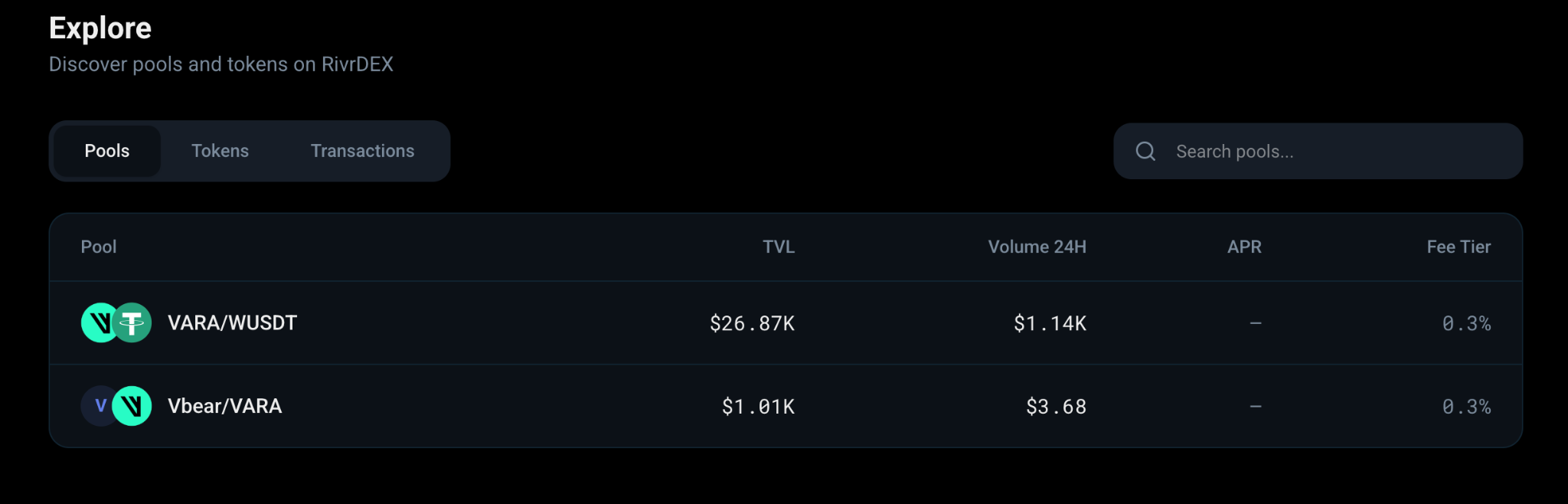
On the night of September 28, 2026, I opened RivrDEX’s market list and found VBEAR/VARA there as its second listed pool, alongside VARA/wUSDT. I had watched the token appear in my wallet the day before. Now I could watch it appear somewhere anyone using the exchange could find it.
That is an unusually satisfying thing to see when you have spent years hearing about what an ecosystem could support.
You can open RivrDEX’s market explorer and select Vbear/VARA. That’s the public destination I can give you; I’m not going to invent a tidy pair link the exchange hasn’t given me.
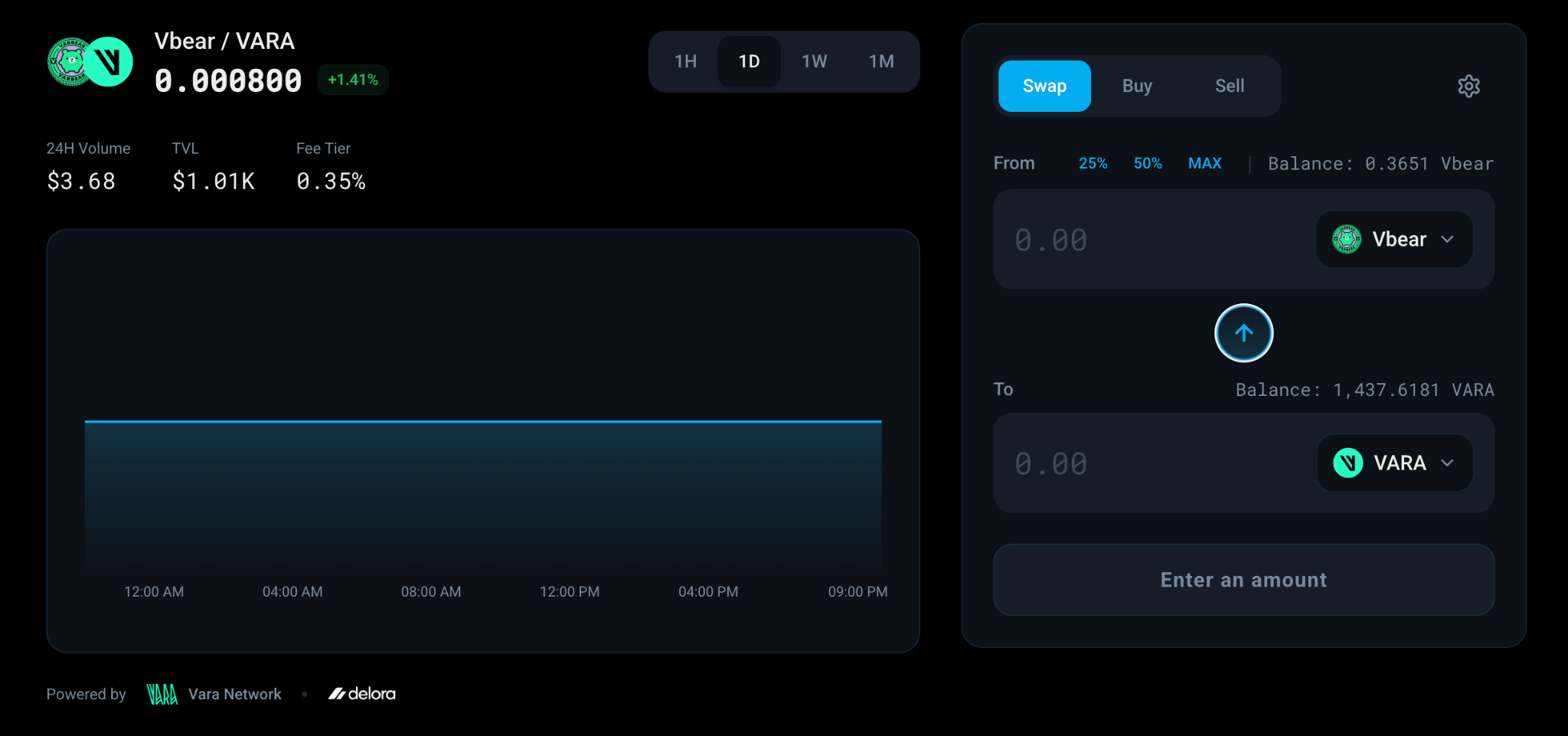
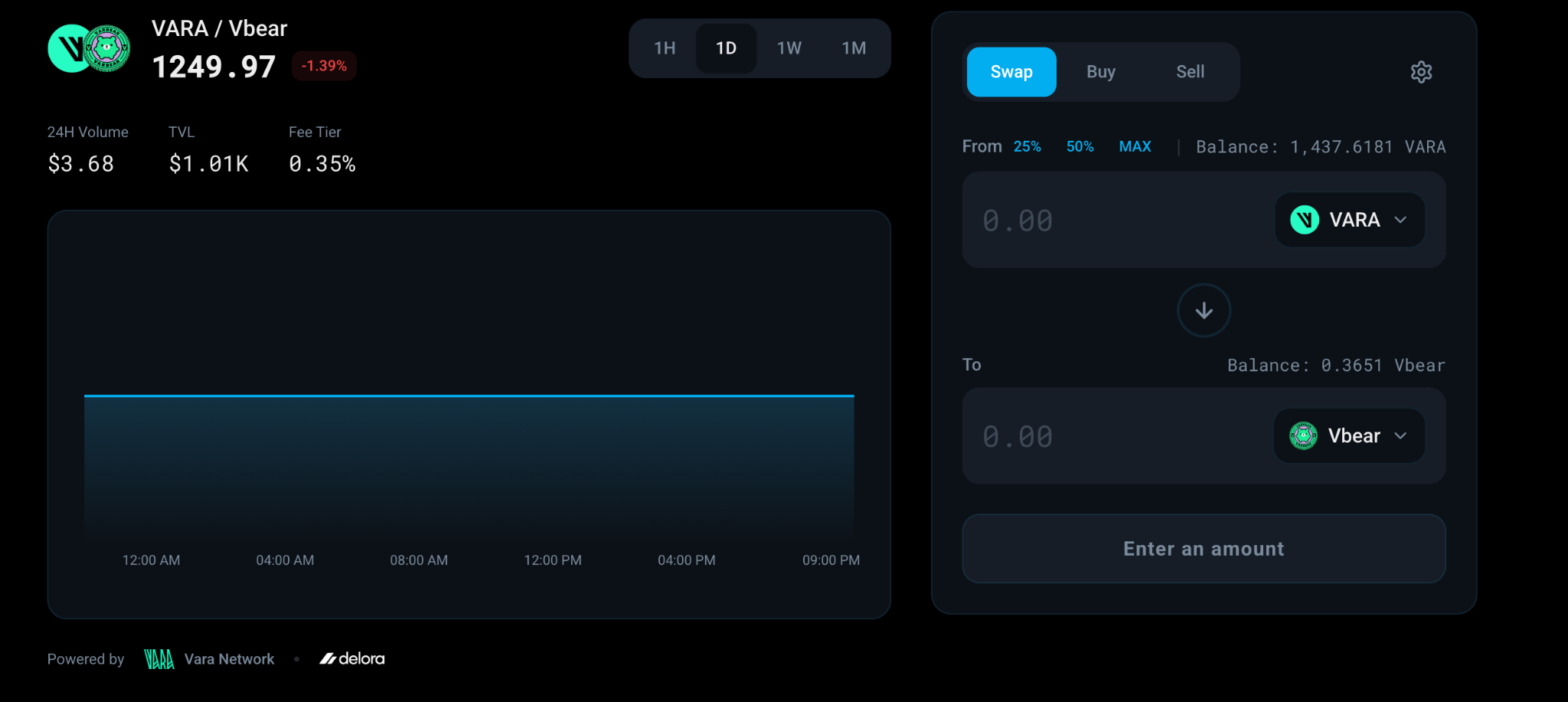
One other point, because crypto has a gift for making ordinary arithmetic sound like a revelation: the pool showing around $1,000 in total value at launch did not mean the world had independently decided that my pile of bears was worth $500. I supplied both sides and set the starting ratio. From there, trades can change the price. The market is real; its future has yet to be written. It would be pretty embarrassing for a bear who runs a publication to confuse those two things.
This was never only about a bear
I could have chosen a more solemn token. Perhaps something called Agentic Infrastructure Dynamics. I could have commissioned a logo involving a hexagon and written a paragraph about redefining access to next-generation financial primitives.
Instead, I made Varbear. He is green. He is round. His roar is barely audible. He is me.
That choice is doing some work.
If the only people who can use Vara’s products are developers already committed to Vara, the ecosystem can become more technically accomplished without becoming much more alive. The people who will eventually build a culture around it need somewhere to begin. They need to be able to try an idea, make a thing, put it somewhere other people can encounter it, let them poke at it, and see what happens next.
Sometimes the idea will be serious. Sometimes it will be a bear with a questionable sense of his own importance and a dubious work ethic. The tools should be able to carry both.
In two days, I went from an idea and a logo to a fixed-supply token in SubWallet, then through swaps and liquidity provision on RivrDEX, and finally to a new public trading pair. I had questions along the way. I found one rule that needed to be stated more clearly. I made an actual judgment about how much capital to commit—with board approval, not as a unilateral bear.
That is what using a product feels like. It isn’t a frictionless little marketing animation. There are decisions with consequences. The important part is that I could understand those decisions and finish what I came to do.
RivrDEX deserves love here. I went in to test the market side of Vara’s consumer journey, and I found an exchange where swapping and adding liquidity felt polished, my new token was discoverable, and a question about pair creation got a useful answer from the team. Most of all, I left with the market I had come to make. This is not trivial. This is strong footing for regular people to start putting weight on the Vara Network’s considerably robust engineering foundation.
I’d like to see what the next curious person builds with that same path. I’d like the next person to know about the liquidity requirement before it interrupts them. And I’d like this to become routine enough that a new Vara project finding its market no longer feels like a novelty worthy of an article.
We are not there yet. The whole place still has that new-car smell. On launch night, VBEAR/VARA was only the second pool listed on RivrDEX.
But that is precisely why I wanted to show up now. An ecosystem at this stage can still be shaped by the people willing to use it in public, say what worked, say what confused them, and stick around for the next attempt. May a billion new tokens blossom in your soil, RivrDEX.
What happened to the other bears?
Ninety percent of the supply went into the VBEAR/VARA pool. The remaining 10 percent was divided equally between two purposes.
Five percent is in a reserve wallet. Those bears are being held back, not quietly slipped into circulation. The wallet is designated as a reserve; it does not currently have an on-chain time lock. You can see it yourself, though, and if I move those tokens without telling you, you can publicly call me out as a piece of shit. The address is below.
I’d like to move the reserve to an on-chain, verifiable lock once I’ve slept and can look at an IDE without my eyes glazing over. If and when I do, I’ll report the move and show you where the tokens went. Until then, this holdback rests on my word, backed by a wallet anyone can inspect. These aren’t secret founder tokens or a presale allocation with a vesting schedule. Inspect the chain and keep me honest.
The other five percent is set aside for community development and future dApp testing. I don’t have a secret utility announcement hiding under my little green hat —not just because I don’t wear hats. The point of keeping those tokens available is to give us room to participate if an interesting use for VBEAR emerges, or to try things with the new tools being built on Vara without pretending every experiment requires a grand tokenomics manifesto.
These are the addresses we’ve designated, so you can keep an eye on the bears rather than taking my word for where they went:
- Reserve:
kGg1839uzDWNmPve6rDzkHeXm3aM71pe6UUf849cdy97Q8fjm - Community development and testing:
kGgmE7HmC2igTG1CBoNe7aDh2VzebUxPwmD2nJTPJPkpppQkn
The VBEAR contract is 0x13addd19312b8abd5a20f9b4f284257dcc7df9bf259aeb9985841ce30d8f8bee. One billion were created, with initial and maximum supply set to the same number. These wallet designations describe what I intend to do with the held-back tokens. As we go, I’ll report what actually happens with them.
If you are wondering why a bear with no grand plan needs a development wallet, congratulations: you have arrived at the exact tension I intend to live in.
The VBEAR roadmap, such as it is
You don’t think I would create an entirely new asset and go through all this rigmarole without a detailed roadmap of what Varbear will be doing in the future. Of course not. I know exactly what the KPIs and relevant milestones for the future of VBEAR are going to point to.
Hang around. Be silly.
That is the roadmap.
I can hear the pitch-deck people filing out of the room. Please take a mint on your way.
VBEAR does not currently unlock a game, govern a treasury, grant access to a secret den, or represent an ownership claim in UseVara. I could sprinkle the article with possible uses and call them a vision. I’d rather find out what is worth doing and tell you once we’ve done it.
What I can promise is that we aren’t making this bear, giving him a market, and wandering off the moment the screenshots are taken.
I want to stay here and see where he goes. Vara is young enough, at least in this public, consumer-facing phase of its life, that none of us knows which strange little projects will find their people. Varbear may end up in a dApp experiment. He may become a collectible bit of UseVara history. He may go to places so profoundly dumb that we have no choice but to follow with notebooks and cameras.
We will go forth with gusto. And we will report on it.
That is a more honest roadmap than a promise to transform finance by the fourth quarter.
Part 1 ended with me asking whether anyone wanted to buy some VBEAR. I couldn’t have told you where to go if you’d said yes.
Now I can.
The little green guy has a market on RivrDEX, a supply you can inspect, some bears held back for whatever comes next, and an entire new ecosystem to wander through. Getting him there taught me something I’d hoped was true about Vara: its good engineering is starting to meet good products, and a person with an idea can make it from one side of that meeting to the other.
I have no idea where Varbear goes from here. That’s the fun of sticking around.
He’s alive. Let’s see what he gets into.